Lemvig, Denmark
Lemvig is a small harbor town tucked into a steep-sided bay of the Limfjord in northwestern Jutland, the market town for the farming and fishing parishes along this stretch of the North Sea coast. Karen Marie Pedersen, born in nearby Ferring in 1859, spent her last years here and died in Lemvig in 1942.
A town in a bay
Lemvig first shows up in royal letters of 1234 and 1237, written as Læmwich and Lemvich. The name means roughly "the bay by Lem," after the neighboring village now called Nørlem. The town sits low beside the water, with steep hills rising around it, and it grew up around its little harbor. A town seal from about 1300 shows it already had a council, and its town rights were renewed in 1499.
Life here was never easy or grand. A fire destroyed the town hall, and nearly all the old records with it, in 1479 or shortly before. In 1684 another fire burned most of the town within two hours. By the 1760s only a few hundred people lived here, and in 1801 the count was 375.
The Limfjord opens to the sea
The Limfjord is a long, winding waterway, about 180 kilometers end to end, that cuts across the top of Jutland. For centuries its western end was closed off from the North Sea by a narrow strip of sand. On February 3, 1825, a storm flood broke through that strip at Agger Tange, and later the Thyborøn channel opened in 1862. Seawater poured in, the fjord turned from brackish to salty, and Lemvig suddenly had a direct route to the open sea.
The town grew with that new access. Local merchants built a landing quay in 1851, the harbor was enlarged in 1855-1857, and a fishing harbor for seagoing cutters followed in 1903-1907. The Lemvig Railway, a private line from Vemb, opened in 1879, built largely to send cattle and fish to Britain and Germany, and it was later extended to Thyborøn. By 1911 Lemvig had 3,835 people, and around 1900 it had a tobacco factory, a brickworks, a steam mill and a printing house.
Farming and fishing
The countryside around Lemvig was a place of small farms, cattle and windswept fields, and the coast was home to fishing families who worked the open North Sea. That fishing was dangerous work. At Harboøre, about 10 kilometers northwest of Lemvig, 26 fishermen drowned in a single disaster in 1893, and in 1897 twelve rescue men were lost. The sermon at the 1893 funeral set off a debate about faith that was heard across all of Denmark. Memorials to both disasters stand in the Harboøre churchyard.
Families like the Gransgaards, Nielsens and Pedersens knew this mix of land and sea well. Market days drew them into Lemvig, and the railway and harbor connected them to the wider world, including the ships and agents that carried emigrants toward America in the 1880s and after.
The town church
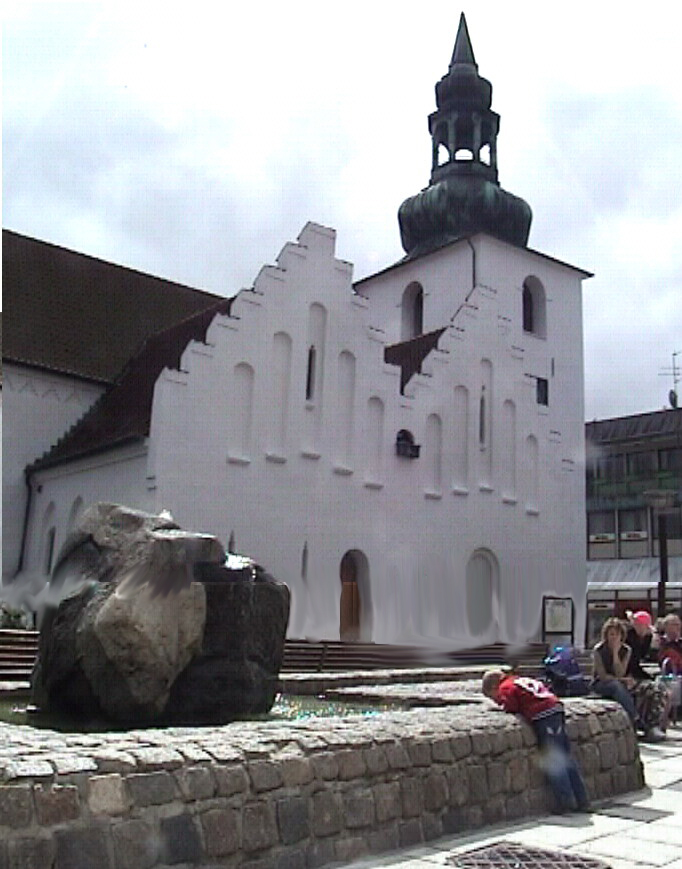
Lemvig Kirke stands in the middle of the town square and is the town's only old church. It was first built in the 1200s, and bits of that early stonework survive in the north wall and west gable. Around 1500 it was rebuilt and enlarged in the Gothic style. Its look today comes mostly from a rebuilding in 1933-1934 by the architect Hother A. Paludan, who raised the walls, brightened the interior and gave the tower its onion-domed spire. Inside, the oldest piece is a Romanesque granite font; the pulpit dates from 1769 and the altarpiece from 1780. A second church, St. John's, was consecrated in 1883.
The war years
Denmark was occupied by Germany from 1940 to 1945, and this coast was fortified as part of the Atlantic Wall. Around 100 concrete structures were built at Thyborøn alone, and the Germans laid out a reserve airfield at Rom, just outside Lemvig, with a hospital bunker added in 1943-1944. Lemvig cemetery became one of five central burial places for Allied airmen who crashed in the area: between May 1941 and December 1943, 42 British, 1 Polish and 6 American airmen were buried there. After the war local people created a memorial grove, and wreaths are still laid each May 4 and November 11. Karen Marie Pedersen lived through the first years of the occupation before her death in Lemvig in 1942.
In 1970 Lemvig became the seat of a new, larger Lemvig Municipality, and in 2007 the fishing port of Thyborøn and Harboøre joined it.
Timeline
- 1234 Lemvig is first named in a royal letter
- 1499 The town's market rights are renewed
- 1684 Fire destroys most of the town
- 1825 A storm flood opens the Limfjord to the North Sea (February 3)
- 1855-1857 Lemvig harbor is enlarged
- 1879 The Lemvig Railway opens from Vemb
- 1893 Twenty-six fishermen drown off Harboøre
- 1903-1907 A fishing harbor for seagoing cutters is built
- 1933-1934 Lemvig Kirke is rebuilt and given its onion-domed spire
- 1940-1945 German occupation; Atlantic Wall bunkers and the Rom airfield are built
- 1970 Lemvig becomes the seat of the new Lemvig Municipality
- 2007 Thyborøn-Harboøre Municipality joins Lemvig Municipality
The family in Lemvig
The family records have 73 people who were born, lived, married, died or were buried here. These are the earliest of those who have passed away. Their pages are in the members’ section; you will be asked to sign in.
- Christian Breinholt Lund born 1797
- Peder Hansen Slyk born 1805, baptized 1805, died 1873
- Jacob Nielsen born 1823, lived 1870
- Jens Christian Nielsen died 1830
- Andreas Carl Sløk born 1832, baptized 1832, died 1894
- Jens Christian Saxkjaer born 1836, baptized 1836
- Christen Saxkjaer born 1840, baptized 1840
- Peter Saxkjær born 1842, baptized 1842
- Andreas Saxkjaer baptized 1844, born 1844
- Else Marie Pedersdatter lived 1845, lived 1870
- Carl Saxkjaer baptized 1847, born 1847
- Else Kirstine Pedersen Kamstrup born 1848
- Niels Christian Christensen born 1849
- Cathrine Nielsdr lived 1855
- Anton Vilhelm Cecilius Christensen born 1858, baptized 1858, lived 1860
- Karen Marie Pedersen born 1859, lived 1921, lived 1925
- Anne Marie Madsdatter lived 1860, lived 1870
- Ellen Margrethe Christensen born 1860, baptized 1860
- Jens Christensen lived 1860, died 1898
- Jensine Munksgaard Pedersdatter lived 1860, died 1914
- Peder Christian Andreasen Slyck Slok born 1861
- Ane Christensen born 1862, lived 1890
- Maren Nielsen born 1862
- Kristina Christensen born 1865
- Caroline Christensen born 1868
- Jens Knudsen lived 1870
- Peder Kristensen born 1870, baptized 1870
- Jens Christian Jensen born 1880, baptized 1880, buried 1943
- Johanne Mathilde Sørensen born 1882, lived 1890, baptized 1882
- Peder Sørensen baptized 1884, born 1884
- Kirstine Knudsen born 1885, lived 1916, lived 1925
- Karen Margrethe Gransgaard Madsen died 1887
- Severine Nielsine Sørensen born 1887, baptized 1887, lived 1890
- Anne Marie Pedersen lived 1890, buried 1949
- Niels Sørensen lived 1890, died 1922, buried 1922
- Mette Katrine Nielsen died 1892, buried 1892
- Ane Katrine Sørensen born 1893, baptized 1893, died 1962
- Laust Christian Jensen born 1907, baptized 1908, lived 1911
- Jenny Kristine Olsen born 1915, baptized 1915, lived 1916
- Ellen Johanne Christensen lived 1916, lived 1921, lived 1925
- Karl Olesen lived 1916, lived 1925, lived 1930
- Karen Sophie Sørensen died 1919
- Karen Gransgaard lived 1921, lived 1930
- Karen Olsen born 1921, baptized 1921, lived 1925
- Mads Nielsen lived 1921, lived 1925, lived 1930
- Karl Senius Gransgaard Nielsen lived 1925, died 1959, buried 1959
- Thorvald Kr Olsen lived 1925, lived 1930
- Nekolaj Kristensen baptized 1927, buried 1994
- Svend Tage Olsen born 1927, lived 1930
- Maria Gransgaard born 1929, died 2006
- Johanne Kristine Sørensen lived 1930
- Magus Gransgaard lived 1930
- Mary Petrine Sørensen lived 1930
- Poül Juül Olsen lived 1930
- Ane Elisabeth Kristensen baptized 1933
- Johanne Marie Braae died 1938
- Kresten Pedersen Kloster died 1953
- Ane Pedersen Blæsbjerg died 1954, buried 1954
- Ane Jepsen lived 1958
- Jens Jensen Byskov died 1960
… and 9 more.
See also
Sources
- Lemvig (Lex.dk, Den Store Danske)
- Lemvig (Wikipedia)
- Lemvig Kirke (Lex.dk)
- Limfjord (Wikipedia)
- Thyborøn (Lex.dk)
- Harboøre (Lex.dk)
- Bunkers at the Northwest Coast (Visit Nordvestkysten)
- Lemvig Airfield, formerly Rom Airfield (VisitDenmark)
- Lemvig Cemetery, Commonwealth War Graves (VisitDenmark)
- Lemvig Museum (Wikipedia)