The Church and Its Institutions
Church Organization
From the time of the organization of the Church in 1782, up until 1911, the different districts were separately organized into conferences for the conducting of the business of the denomination as deseribed in the preceding chapters. The organization, ‘‘The Society of Schwenkfelders,” was started in 1782, but the Church was not incorporated, indeed there was no incorporation of any of the organizations until troubles arising from the Edmund Flinn legacy caused this step to be taken. Mr. Flinn [vid. 154-5] having been benefited by the Charity Fund of the Schwenkfelders made a substantial bequest to the Society in his will. The will was contested by some of his distant relatives on the ground that no corporation of the Society of Schwenkfelders existed, therefore they were incompetent to receive any bequest. The outgrowth of this contest was the incorporation of ‘The Managers of the Literary and Charity Funds of the Society of Schwenkfelders,’’ on May 18, 1842 [Misc. Bk. 8: p 370, Norris-
town, Pa.]. ;
Owing to the expansion and growth of the various organizations of the Church, after the opening of Perkiomen Seminary it was deemed advisable to change the form of government. Whereas prior to 1851 the affairs of the Society were carried on without a printed form of Church rules, the increasing demand and the necessity for a change was met by Rev. Joshua Sehultz who drafted what is called “Constitution der Schwenkfeldischen Gemeinschaft’’ and also the by-laws which were adopted October 19, 1850, and published in 1851, in German, under his editorship. The first English translation appeared in 1882. In 1894, a committee was appointed to revise and amend the constitution, as a result of which a revised formula of the Constitution was adopted in 1898, and again revised in 1901. In May, 1908, a further revision was deemed necessary and another committee was appointed to make whatever revisions were necessary and also to correct conflicting statements in the articles relative to the administration of the moneys in the Charity Fund. The fruits of the work of this Committee resulted in the adoption of the ‘‘Formula for the Government and Discipline of the Sehwenkfelder Church,” as on Oct. 25, 1909, the organization was incorporated under the title, ‘‘The Schwenkfelder Church.’’ The new constitution was put into effect in 1911. Under this constitution the entire Church body is officially called the “‘Schwenkfelder Church’’ which is dominated by the General Conference of The Schwenkfelder Church, which is composed of all its members, and this is the governing body for the entire Church. Regular sessions of the General Conference are held twice a year, the third Saturday in May and the third Saturday in October, and its officers consist of the Moderator, Secretary, and Treasurer who, together with the trustees of each local district, constitute the “Board of Trustees of the Schwenkfelder Church.”
Each district of the Church has its own district conference and elects its own officials, who look after the temporal and spiritual needs of the local church organization. All other boards such as the Mission Board, Board of Publication, and the Board of Charities are under the control of the General Conference of the Schwenkfelder Church body.
Church Edifices
Prior to the erection of church buildings formerly called ‘“‘meeting houses,”’ divine services as well as church conferences were held in private homes, and, although a school house was erected in 1765, in Towamencin, buildings for strictly public worship were not erected for twenty-five years thereafter.
Hosensack Meeting House
The first place for public worship built by the Schwenkfelders in America, was built of logs in the summer of 1790, where the present Hosensack meeting house now stands. The first services in this building were held August 8, 1790. At one end of this building a school-room was partitioned off, supplied with benehes and tables, in which room the ““Hosensack Academy’ was conducted by the Schwenkfelders for a number of years, during which time the Schwenkfelder schools attained their highest distinction.
In 1838 the log building was replaced by a more modern plain stone structure which was remodeled in 1893, and is still standing although abandoned for Church purposes since the new Palm Church was - completed.
See the original page
Washington Meeting House
The second meeting house was erected in 1791, near the village of Clayton, Berks County, and was known as the Washington Meeting House, although burials in the adjoining cemetery antedate the erection of the building, as the wife of Melchior Schultz who died in 1742, is buried there. The first services were held in this building on Memorial Day, Sept. 24, 1791, at which time Rev. Christopher Kriebel delivered a magnificent dedicatory address. In 1810 the adjoining burial plot was surrounded by a stone wall, and in 1824 a more modern building was erected against the protest of some of the members who thought it sacrilegious to destroy the old buildings and others who favored the erection of a new building in a more central location in the region of Palm, Pa. This movement culminated eighty-
seven years later in the erection of the present Palm Church. ,
In 1883 the Washington Meeting House was entirely remodeled, and after the completion of the Palm Church the building was torn down and a marker erected to indicate the spot where the pulpit had formerly stood; the stones from the walls of the building being used to enclose the entire plot with a handsome stone wall.
Kraussdale Meeting House
The first Kraussdale meeting house was built in 1825 although it is claimed by some that the first building was erected in 1815, and here, as in Washington, burials of Schwenkfelders on the Krauss “farm” had taken place for many years prior to the erection of this building. The first building erected here was used for both school purposes and for divine worship. It was a rough stone building with the joints painted white.
In 1875 the old stone building was replaced by the present brick structure, which was remodeled in 1900, and was abandoned in 1911 when the new Palm Church was dedicated.
The New Palm Church
The demand for better Sunday School facilities was the climax which brought about the erection of the Palm Church. Ever since the three churehes were erected it was customary to have alternate preaching services in the different churches from Sunday to Sunday. This meant services in each meeting house were held but once in three weeks, with a Sunday School session preceding the preaching services. Thus practically a different group of Sunday School children assembled at each building, as very few were able to attend the session on each Sabbath on account of the geographical location of the Church edifices.
When therefore in 1909, in order to modernize the Sunday School, at a district conference thepastor offered a resolution to the effect that additions be built to the old meeting houses in order to provide better facilities for conducting the Sunday Schools, various members opposed the spending of any more money on the old buildings, and the motion was voted down unanimously. Another motion was then made that a new house of worship, centrally located, with ample accommodations for Sunday School purposes, be erected. Thus a movement started eighty-five years before, and which was agitated every time repairs to the old buildings were made, was brought to a climax, and the handsome new church at Palm was erected at a cost of approximately $65,000.00, with the entire amount pledged at the time of dedication, which took place September 24, 1911. [For further data re Upper District Churches, vid. Schwenkfeldian, Vol. VIIT, p 189; Schwenkfelders in Pa.— Kriebel, pp 82-3.]
Salford Meeting House
The present Schwenkfelder meeting house at Lower Salford was erected in 1869. Although this is the first meeting house erected on this spot a school house previously stood to the north of the present structure in which a school was conducted for many years. Rev. George Meschter, Sr., who served this Church faithfully was the last active pastor. The older Schwenkfelders in the vicinity of the church dying, and many of their children marrying outside of the denomination, the attendance dwindled so that services were finally conducted but once in three weeks during the summer time and these were conducted in the German language.
In 1920, Isaae Kriebel, who owned the farm adjoining this property and who had eared for the church and cemetery for so many years, died. He was the last active Schwenkfelder in the congregation, and since his death regular services have been discontinued. Memorial services in memory of the pioneer Sechwenkfelders who lie buried in the adjoining cemetery are now held in the meeting house on the afternoon of the first Sunday in August of each year.
See the original page
In the adjoining cemetery lie buried five Schwenkfelder ministers—George Weiss, Balzer Hoffman, Christopher Hoffman, Christopher Kriebel, and George Meschter. Tradition states that a number of Indians are buried in the unmarked row of graves in the middle of the cemetery.
Towamencin Meeting House
The first meeting house in the so-called Lower District (now Middle or Central) was built in 1793, near where the present edifice stands. It is likely that this building replaced the school house erected there in 1765. This building was made of logs, pebble dashed, with gable ends, weather boarded and painted red. There was a portico in front with seats on each side. The first services were held there on July 21, 1793.
In 1854 this building was replaced by a stone structure which did service until 1893, when the present handsome brick edifice was erected a short distance from the older building on the opposite side of the road. The new building contains a commodious basement with room divisions for Sunday School purposes. The floor of the main room is built amphitheatre style so that a good view of the pulpit is commanded. The building was dedicated free of debt with a surplus left in the treasury of the building committee.
Worcester Meeting House
In 1836 the first Worcester Schwenkfelder Meeting House was erected on the spot where the | present edifice stands. It was dedicated September 25, 1836. It is said that $25.00 was the largest individual subscription made to the building fund.
In 1882 the present modern church building was erected to replace the first structure. It is said to have cost $6,000.00 and was dedicated free of debt according to the prevailing Schwenkfelder custom. This building was the first Sechwenkfelder Church structure to contain a basement for Sunday School purposes. This innovation met with vigorous opposition on the part of many members.
The First Schwenkfelder Church Of Philadelphia
The present Schwenkfelder Church of Phila. was started as a Sunday School Mission on Uber St., between 19th and 20th, in the fall of 1895, with Elmer K. Schultz as Sunday School Superintendent. This Sunday School Mission, which was the first missionary effort of the Board of Home and Foreign Missions of the Schwenkfelder Church in the home field, continued under the jurisdiction of the Mission Board until May, 1899, when the First Schwenkfelder Church of Philadelphia was regularly organized and received into membership of the General Conference as a “‘District’’ of the Church.
The Sunday School on Uber St. was closed in the spring of 1896, after one season of work, but was opened again on ‘the first Sunday in December, 1896, in the Thomas Building at Ridge Ave. and 31st St., with Elmer E. 8. Johnson, then a student at Princeton University, as Superintendent. The Thomas Building continued as the home of the ‘‘mission”’ until the summer of 1898, when the lot at 30th and Cumberland Sts. was purchased and all services were held in a tent erected on the lot until the last Sunday of October, 1898, when the present edifice was dedicated with three special services which marked a memorable epoch in the annals of the Schwenkfelder Church, as it must be regarded as the first permanent step in the direction of church expansion in the Schwenkfelder denomination.
On November 19, 1898, the church was organized with seventeen charter members, and the Moderator, Dr. James M. Anders, and Secretary, Samuel A. Seipt, have served continuously in that capacity to the present day.
For about a year previous to the dedication of the Church, preaching services were held semimonthly, mostly by supplies from other districts, but the only organized work conducted up to that time was that of the Sunday School. Not having a sufficient supply of ministers amongst the Schwenkfelder denomination, the Board of Missions was obliged to look to other denominations to supply the pulpit, until it was able to select a pastor of the Schwenkfelder faith.
The following is a list of pastors who served the Church:
May 1899—Oct. 1900; Rev. A. N. Stubblebine of the Reformed Church.
Mar. 1901—Aug. 1902; Rev. H. A. Bomberger of the Reformed Church (acting pastor).
Sept. 1902—June 1904; Rev. Elmer E. 8S. Johnson of Schwenkfelder Church.
July 1904—Oct. 1905; Harvey K. Heebner, Stated Supply.
Jan. 1906—May 1906; Rev. David W. Ebbert, D.D., of the Reformed Church (acting pastor).
See the original page
During the intervening periods when the Church was without a pastor the pulpit was filled with supplies, sometimes by ministers of other denominations, and other times by laymen of the Schwenkfelder Church.
Since June, 1906, the pastor has been Rev. Harvey K. Heebner, who was formally installed as _ pastor on Sunday evening, Sept. 23, 1906. Rev. Heebner was graduated from the Union Theological
Seminary in May, 1906. ; ‘
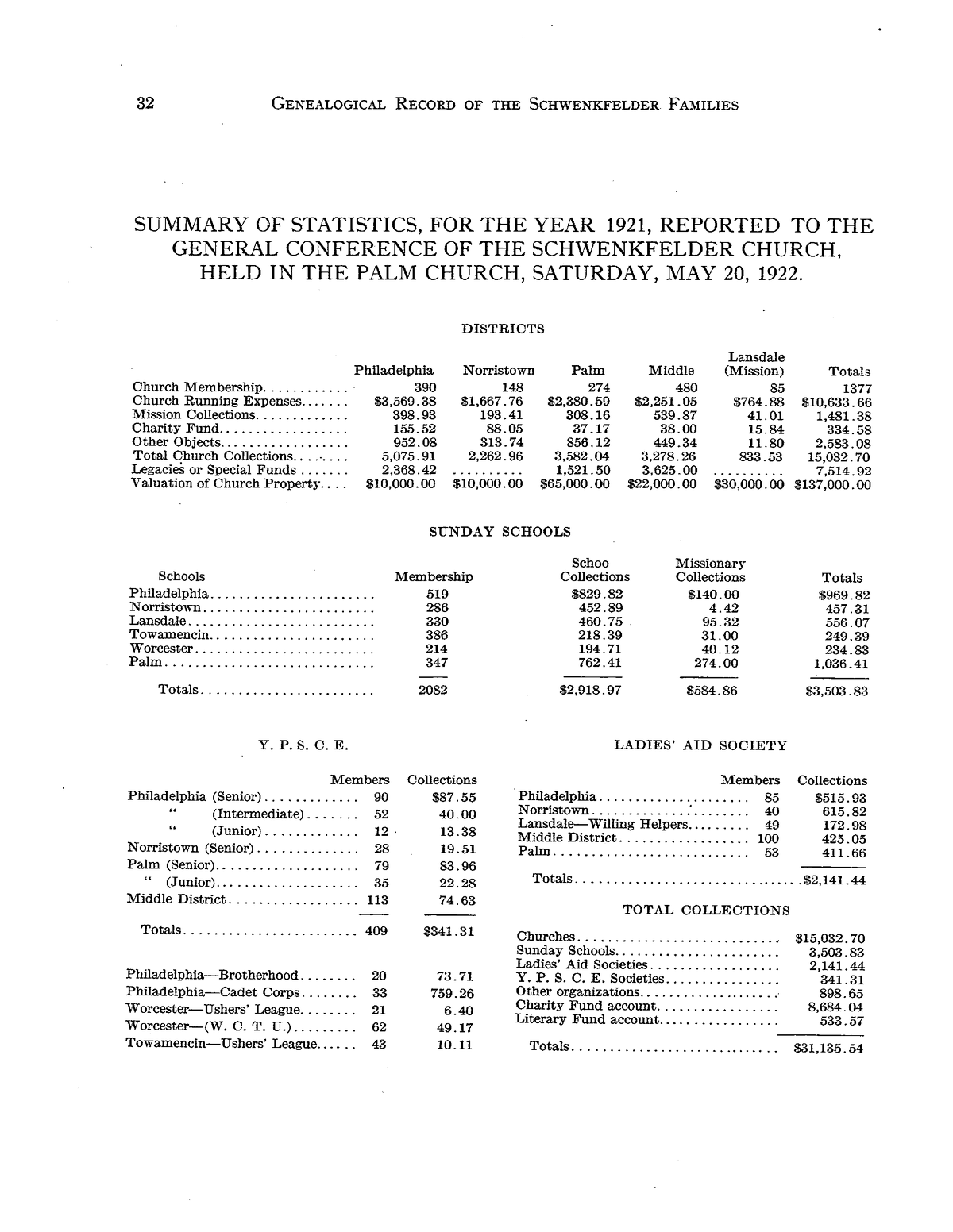
For the year 1921 the Philadelphia Church reported the following membership to the General Conference:
     Church Members                     390       Members of Sunday School... ..
                     sec eee ee eee eee                                              519 |
     Collection—Chureh                 $3569 .38    Collection—Sunday School.....
$829 . 32
Valuation of Church Property $10,000.00
Norristown Church
The first religious services of the Schwenkfelders held in Norristown were conducted in a private house on Feb. 7, 1904, and on Feb. 21, a Sunday School was organized in one of the publie school buildings, which was followed by preaching services. Services in the schoolhouse continued until June, 1905, when the first services were held in the edifice at Marshall and George Streets which had been purchased by the Schwenkfelder Mission Board from the Grace Lutheran Church denomination. This is the only instance in the history of the Church that the Schwenkfelders purchased a building of another denomin- -ation., The building is modernly equipped with class rooms for Sunday School purposes and has an adequate pipe organ.
The. Norristown mission was the second one established by the Mission Board of the Church. In 1917 the mission became an independent church.
Statisties of the Norristown Church for 1921:
             Church Members.........0.00 00000 c ccc ccc eee cae eeaeees    148
             Total Collections...0.0..0.000           000    cc   ce eee eee eee eee $ 2,262.96
             Valuation of Church Property..........0.0.0..0 06 cee eee nee $10,000.00
The Sunday School had an enrollment of 286, with collections amounting to $452.89.
Lansdale Mission
A Sunday School was opened in Lansdale in Music Hall on Mar. 26, 1916, under the jurisdiction of the Mission Board. The mission grew very rapidly and with so much enthusiasm that the quarters soon became so crowded that it was necessary to find new accommodations. Land was purchased at the corner of Main St. and Towamencin Avenue. Ground for a new building was broken in June, 1917, and the building itself was completed by December of the same year, but on account of the war conditions the pews could not be obtained until April, 1918. The Church was dedicated May 5, 1918, free of debt as the entire cost was pledged on that day. The building is built of stone, of fine proportions, with a seating capacity of 330, and is well equipped for Church and Sunday School purposes, and contains a eommodious basement.
Tt is still organized as a mission, and for 1921 reported a Church membership of 85; a Sunday School membership of 330; with Church property valued at $30,000.00.
The above constitute the entire Schwenkfelder Church congregations, as the Church as such exists only in Eastern Pennsylvania and consists of but four church organizations, and the Lansdale mission. There are no Schwenkfelder organizations in Europe.
Early in 1800 the group of Schwenkfelders living in Chestnut Hill and vicinity petitioned the General Conference of the Schwenkfelder Church to establish English preaching services in Chestnut Hill. After due deliberation the Conference decided to comply with this request providing the services be conducted in the German language, but the petitioners would not recede from their desire to have English services, and the project was abandoned, and thus the opportunity to establish a Schwenkfelder Church in Philadelphia was not grasped by the leaders of the denomination of that period. It was almost one hundred years afterwards that the newly organized Mission Board of the Schwenkfelder Church heeded a second call and established services conducted in English.
Services in the English language were first introduced in the Worcester Church in the early 80’s, and this church was the first to discontinue the use of German. At the present time services are conducted exclusively in the English language in all the churches, with the exception of Palm and Towamencin, where services are still occasionally conducted in the German language.
See the original page
Board Of Missions
The American Board of Home and Foreign Missions of the Schwenkfelder Church of the United States of America held its first meeting, and was formally organized on June 14, 1895. Whereas the Church, preceding that time, had been interested in missions to the extent of making contributions to various missionary enterprises, there was no formal organization in the Church to look after this phase of the work. The organization of the Mission Board marks the beginning of the expansion of the Schwenkfelder Church. Since its organization it has established missions in Philadelphia, Norristown and Lansdale; and it has sent two of its own members as missionaries to the foreign field.
Miss Flora K. Heebner [199-5] left for China August 17, 1904, and was joined a number of years later by Daisy Gehman Fairfield [38-348]. Since 1918 the Board is also contributing to the support of Miss Gladys Williams of Oberlin College who has joined the mission force in Shansi, China, and has been adopted as a missionary of our denomination. Miss Williams was born in Tai Ku, China, where her father was killed by the Boxers in 1900. Since Miss Heebner went to China she has been home on two furloughs and has organized mission schools throughout the province of Shansi. The Schwenkfelders have two mission buildings in China; one the ‘William Yeakel Meschter Memorial Home’’ for the women teachers which was built from a legacy of one thousand dollars left by Mr. Meschter to the Board of Missions, the first legacy the Board ever received. Since that time a school building has been built by Miss Heebner with a fund made up by special gifts of her friends here in America, This mission station is established in the region where the missionaries were killed by the Boxers during the Boxer uprising in 1900. In addition to mission work in China the Board also makes contributions for the support of missionaries in other foreign countries.
Other Schwenkfelder Institutions
The Charity Fund
The Charity Fund of the Schwenkfelder Church had its origin before their arrival in Pennsylvania. As told in the preceding chapter the von Buyssant family paid the passage way of the immigrants of 1734 to Philadelphia thus freeing them from the slavery of the redemptioner, and in addition gave them a purse of 224 Rix dollars to aid the poor among them after their arrival in the new world. This was the beginning of the Charity Fund of the Schwenkfelders in Pennsylvania. No records have been found to show how this fund was used during the first winter in their new home.
In 1768, after the death of Dr. Abraham Wagner, it was found that he bequeathed one-third of his estate to the poor and needy, not only to Schwenkfelders, but to other denominations also. The sum bequeathed amounted to 448 pounds, 12 shillings, and 334 pence. In 1768 is found the first instance which led to the establishment of the Schwenkfelder Charity Fund as it is called today. From 1774 to 1778 we find the Charity Fund benefiting by the Wagner bequest. ‘Since then the fund has been increased year by year by gifts, donations and bequests.
Ever since 1790 separate accounts of the Charity Fund were kept in every district. This method continued uutil the consolidation of the Church in 1911, when it was taken over by the General Conference and a board of five managers was appointed to manage this fund. For the year of 1921 there was reported a balance in the Charity Fund of $8,684.04.
Memorial Day Services
According to the custom established by the immigrant Schwenkfelders on September 24, 1734, when they assembled in Philadelphia and held a thanksgiving service in memory of their safe arrival in this country the practice has been continued ever since. Every year on September 24 (unless that day should fall on a Sunday, when the exercises are held on the preceding Saturday) an all-day service is held in one of the churches belonging to the denomination, at which time the early history of the persecutions of the Schwenkfelders and an account of their migration and settlement in this country are rehearsed by the speakers.
Even during the dark days of the Revolution when the British were in possession of Philadelphia these services were held, although in the year 1777 services were held for a half day only on account of the proximity of British soldiers. It is stated that at the first services in Philadelphia, for the noon meal, bread, butter, apple butter, and cider were served. The same custom prevails up to this time excepting that water has been substituted for cider. The one hundred and eighty-seventh annual memorial
See the original page
day services were held in the Palm Church on September 24, 1921. The services were formerly called “Gedaechtnisz-Tag”’ services which has been modernized into ‘“Memorial Day Services.”
Sunday Schools
The Schwenkfelders have always emphasized the idea of home instruction for their children. George Weiss was appointed teacher or leader while on the journey to Pennsylvania and he was succeeded by other Schwenkfelder ministers in turn. While there were no Sunday School organizations at this time, still the children were given Biblical instruction by the ‘‘Lehrer’’ (teachers). After the church structures were erected regular catechetical instruction for the young was instituted. This was called ‘‘Kinder Lehr’ and was frequently conducted by alayman. The class met on alternate Sunday afternoons. Towards the middle of the last century the custom of giving children instruction in religion and the Scriptures in the home seemed to be dying out, and the leaders of the denomination deemed it necessary to devise some other means in which such knowledge could be imparted. The general conelusion was to organize a Sunday School. Since the literature of the Church at that time was all in the German language and German was no longer taught in the day schools, the fathers conceived the idea of organizing Sunday Schools in which the German language would be exclusively taught. With this idea in mind a meeting was held in the Towamencin Meeting House, March 16, 1861, for the purpose of considering the feasibility of organizing a Sunday School in the Lower District. The conservatives of the denomination opposed this scheme very strongly as they thought it would break up the catechetical classes, and they also thought the children would be in more danger of growing up in worldliness and fashion. As the progressives prevailed the first session of the Sunday School was held May 10, 1861, in the Towamencin Meeting House. A Sunday School was also organized in the Woreester Church in the same manner with Rev. Reuben Kriebel as superintendent, all services being conducted in the German language. It is stated that this Sunday School continued during the summer until 1863, when a large number of the younger element insisted on having the English language used in the Sunday School while the older members desired to continue the German. This division of sentiment closed the school for a time. It is stated that finally those desiring the English language used prevailed and the Sunday School was again opened in 1864, with David S. Heebner as superintendent.
The Towamencin Sunday School has had continuous summer sessions since 1861, and in 1911 celebrated the fiftieth anniversary of the opening of the school, at which time thirty of those present were original members of the first Sunday School session. In the Towamencin Sunday School the German language was used exclusively in conducting the exercises until 1888, when English was introduced, but some of the classes still continued the use of the German language. The use of the organ to accompany the Sunday School singing was first begun in 1880.
In the Upper District the first Sunday School in that section was held in the Kraussdale Meeting House on April 8, 1877. Two years later a school was opened in the Hosensack Meeting House and in the following year a school was organized with the same officers in the Washington Meeting House. These schools continued their sessions until they were combined with the one Sunday School in the new Palm Church, where the first session was held October 11, 1911. Mr. Daniel Y. Meschter served as superintendent of this school from the spring of 1886 until May 28, 1917. It is an interesting fact that in all the missions established by the Schwenkfelders, the Sunday School preceded the establishment of the church, whereas the original meeting houses were established with preaching services before the Sunday Schools were organized.
Ladies’ Aid And C. E. Societies
The first Ladies’ Aid Society of the Schwenkfelder Church was organized Oct. 11, 1898, in the Upper Distriet. Since that time Ladies’ Aid Societies have been organized in Philadelphia, Middle District, and Norristown, all of which are in a flourishing condition.
The first Christian Endeavor Society was organized in the Kraussdale Church, March 25, 1894, with Elmer E. 8. Johnson as president. Since that time Christian Endeavor Societies have been organized in all the other churches and missions. The Middle District also supports a Woman’s Christian Temperance Union which has had a period of more than twenty-five years of active work.
The Board Of Publication Of The Schwenkfelder Church
At the annual Memorial Day services held in the Worcester Church, Sept. 24, 1884, a plea was made by one of the speakers that all the works of Caspar Schwenekfeld be collected and published.
See the original page
Following out this plea soon after, a committee was appointed by General Conference to consider this proposition. This was the beginning of the Board of Publication of the Schwenkfelder Church which was later incorporated and it now has jurisdiction over all the publications of the Schwenkfelder Church.
Corpus Schwenckfeldianorum
The greatest undertaking of the Board was the project to collect, edit, and publish the complete works of Caspar von Schwenekfeld, a task which has grown to be monumental. This work is now being published jointly by the Board of Publication of the Schwenkfelder Church and Hartford Theological Seminary, and is to consist of seventeen volumes of an encyclopedic size, of which six are already in print under the title of ‘‘Corpus Schwenekfeldianorum,”’ and which project has already cost the Board of Publication more than one hundred thousand dollars. This is to be followed by a one volume edition in English giving the biography of Caspar von Schwenckfeld. The work was started by Chester David Hartranft, D.D., [49-320], formerly president of Hartford Theological Seminary, who was selected as editor-in-chief of this publication and who had his headquarters in Wolfenbiittel, Germany, where he died in 1914 [vid. Schwenkfeldian, Vol. XII., pp 34-48]. Dr. Hartranft was succeeded as editor-inchief by his associate editor, Dr. Elmer E. 8. Johnson [68-58], who continued his editorial labors in Germany until April of 1919, when he brought all his Corpus material to America and stored it in the Schwenkfelder Historical Library Building at Pennsburg, Pennsylvania. The library is now the editorial home of the Corpus.
The Board of Publication also has charge of the publication of the “Schwenkfeldian,” the Church paper. The publication of this Genealogical Record is also under its jurisdiction as well as other chureh publications.
The Schwenkfeldian
“The Sehwenkfeldian”’ is the official organ of the Sechwenkfelder Church. It was first started by Rev. E. E. S. Johnson when he was pastor of the Philadelphia Schwenkfelder Church in the interest of the First Schwenkfelder Church in Philadelphia. The first issue appeared December, 1903, with the following editorial staff:
Rev. E. E. 8. Johnson, Editor
Allen A. Seipt, Associate Editor
C. M. Gilbert, Jr., Business Manager
Alex. S. Day, Circulation Manager This publication was continued in this way until Rev. Johnson was appointed assistant editor of the Corpus Schwenckfeldianorum, and left for Germany in June, 1904, to assume his duties.
Samuel K. Breeht was then appointed acting editor during the absence of Mr. Johnson, and JLeidy Anders was made assistant business manager. The paper was published under this Editorial Staff until June, 1905, when the General Conference of the Schwenkfelder Church by official action took over the paper and made it the official organ of the Church. The paper has been published as a monthly magazine in the interest of the various churches since that time.
On account of the arduous duties of the Editor in connection with the editing of the Genealogical Record of the Schwenkfelders, Rev. Harvey K. Heebner was made acting editor of the paper in 1920, and it is now issued from Thirtieth and Cumberland Streets, Philadelphia, Pennsylvania, and has the following staff:
Samuel K. Brecht, Editor
Rev. Harvey K. Heebner, Acting Editor
Rev. Levi S. Hoffman | . .
Rev. Robert J. Gotischall Associate Editors
Rev. E. E. 8. Johnson gs .
Miss Flora K. Heebner Contributing Editors
In addition to publishing the monthly news pertaining to the various Schwenkfelder Churches, the Schwenkfeldian, during its period of existence, has printed on its pages a large amount of historical data connected with the Schwenkfelders, and its circulation extends to many states of the union as well as to several foreign countries.
See the original page
The Schwenkfelder Historical Library
The Schwenkfelder Historical Library at Pennsburg, Pennsylvania, is also under the jurisdiction of the Board of Publication of the Schwenkfelder Church. The project to erect a fire-proof building to store the precious books and manuscripts found in the Schwenkfelder families was thought of many years ago. Asa matter of fact theidea was suggested at different times more than fifty years before the project was completed.
The Schwenkfelders brought with them from Europe many books which they prized very highly and which were carefully preserved from generation to generation. The idea of having a permanent home for these valuable objects was in the minds of the leaders of the denomination for many years. After the taking over of Perkiomen Seminary by the Schwenkfelders a room in the gymnasium was provided for storing these papers temporarily. It was only after the magnificent donation of Andrew Carnegie of twenty thousand dollars for the erection of a fire-proof library building that the dream of having a permanent home for the Schwenkfelder archives began to be a reality. As a result of this donation together with an endowment of an equal amount which was provided by friends and members of the denomination, it was possible to erect the handsome two-story fire-proof buildingat Pennsburg, Pa., the second fioor of which contains the rare collection of Schwenkfeldiana and other relics that are prized so highly. In addition to having the building fire-proof it also contains a vault which is doubly fire-proof extending from cellar to roof. It is in this vault that the rarest documents and relics are stored. The main floor of this building contains the reading room and reference and circulating library which belongs to Perkiomen School and the basement provides class rooms and laboratories for class work. Perkiomen School holds the unique distinction of being the only exception to Andrew Carnegie’s rule not to erect libraries for other than institutions of collegiate grade. It is the only secondary school in the country which benefited in this manner by Andrew Carnegie’s generosity.
The Schwenckfeld Bible
The two most highly prized relics reposing in the Schwenkfelder Historical Library at Pennsburg are the original Ship List of the St. Andrew and the German Bible used by Caspar Schwenckfeld which contains his autograph and also marginal notes in his own handwriting.
This Bible was printed at Worms in 1529, and this edition is the first of the combination Bibles to appear in the German language after the beginning of the Reformation. It is known as the ‘‘Worms Bible,” and antedates the complete Luther Bible by three years.
In 1890 the late Dr. Chester D. Hartranft located this Bible in Europe and through the generosity of the late Anthony H. Seipt it was immediately purchased, at a cost of $525.00, the church afterwards reimbursing Mr. Seipt for his outlay.
{For a , account of the history and acquisition of this Bible see ‘‘The Schwenkfeldian,’”’ Vol.
VI, pp 3-5. ,
Education Among The Schwenkfelders
That the immigrant Schwenkfelders were of a high type of intelligence is shown by the fact that very few of them made “their mark” at the time of taking the Pledge of Allegiance. Soon after their arrival in America evidence has been found to show that they were very much concerned not only regarding the religious but also the secular education of their children. During the first few years it is probable that their religious leaders gave instruction to the children in secular matters as well as in spiritual. From the biography of Rev. Christopher Schultz written by his son, David, we know that even before coming to this country Christopher Schultz went regularly, two to three times a week, to George Weiss to receive instruction in the languages. This instruction likely continued after their arrival in Pennsylvania, After the death of George Weiss his successor, Rev. Balzer Hoffman, continued this instruction. Letters are extant showing that Balzer Hoffman gave Christopher Schultz lessons in Hebrew by correspondence (vid. Balzer Hoffman [106-2]). We are justified in concluding that this was not the only instance of Balzer Hoffman giving instruction to the young. In the year 1764 there seemed to be quite a demand for Schwenkfelders to establish a school system in order to instruct the young. The necessity for such schools was laid before the heads of families at a meeting held in March, 1764, when a paper was written asking for the pledge of funds for the support of the schools. In June another meeting was held when articles of agreement were adopted and the system was inaugurated. The following is a list of names of the subscribers and supporters of this proposed school system, together with the amounts of money subscribed by each:
See the original page
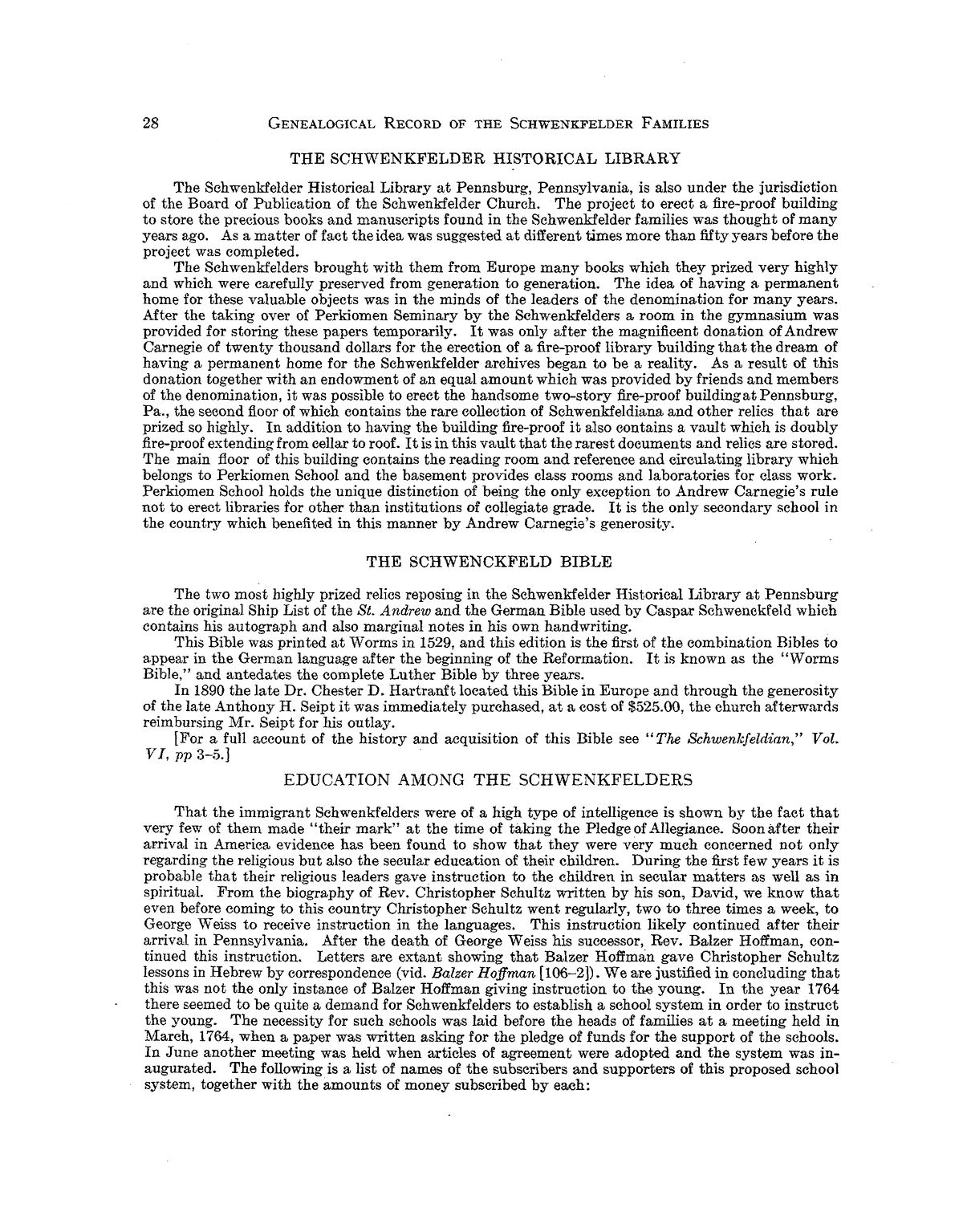
  Christopher Schultz....... £50 a loan           Casper Kribel............. £50 a loan
  George Schultz............ 30.Ciéi«S            George Kribel, Jun........ 30S
  George Sehultz, Jun.......   50“            Abraham Kribel...........   30S
  Melchior Schultz..........   50    =“            George Anders Sen........    5    CO
  Barbara Yeakel...........   40    =‘            George Anders, Jun........   20
  Andreas Warmer.......... 20    =«(*            Melcher Krebel........... 20    =“
  David Schultz............   10)    Of            Casper Seibt..............   30.0
  Christoph Krause......... 40    *            Christoph Neumann....... 20    «=
  Christoph Yeakel..........   50S            David Neuman...:.......   25    *
  Balthasar Krause..........   10    “   |          Heinrich Schneider........ 20    “
  Johannes Yeakel..........   50.“            ‘Abraham Yeakel.......... 20    =
  George Heydrich..........    6 a donation      Gregorius Schuttz......... 20
  George Kriebel............ 30 a loan           Rosina Wiegner........... 30 Nov. 27, 1766
  Christoph Kribel..........   30.                 Andreas Haag............    4 a donation
  Christoph Hoffman........ 20    “
  Hansz Chr. Huebner....... 30    “                     Summa.......... £840. 0. 0
The 840 pounds originally subscribed were reduced to less than 800 by the withdrawal of afew subscriptions when the schools were opened. Two schools were opened in the fall of 1764. One school was conducted for six months in the home of Christopher Schultz by John Davis at a salary of 20 pounds and board for the term; another school was established in the home of George Anders of Towamencin and taught by John Doerbaum for the sum of 10 pounds, board, light and fuel. These schools were continued with practically an unbroken record until 1823, when the opening of the public schools by the state removed the great necessity for having denominational schools. [For further account of the Schwenkfelder Schools vid. Schwenkfelders in Pennsylvania— Kriebel, pp 120-138.]
From this time on, up to the purchase of Perkiomen Seminary by the Schwenkfelders, the denomination as such did not have schools of its own as the public schools of the state provided sufficient opportunity for the education of the children.
Perkiomen Seminary Now Perkiomen School
Perkiomen Seminary was founded in 1875 by Rev. Charles S. Wieand [11-130], and was continued under his management for a period of ten years. After Rev. Wieand left the school to assume the regular duties of the ministry the property frequently changed hands and it was finally found necessary to close its doors because of lack of sufficient patronage. During the year 1891 the project of having the Schwenkfelder denomination establish a private school, where their children and the youth of the community might secure additional facilities for education than those that were provided in the public schools was again agitated. At the fall General Conference of the Schwenkfelder Church held in the Worcester Church on October 9, 1891, a resolution was adopted authorizing the appointment of a committee to make an investigation as to the feasibility of establishing a school for secondary education under the jurisdiction of the Schwenkfelder Church. The committee made a canvass of the situation and at the next spring General Conference held on May 14, 1892 the committee made a very optimistic report to the effect that total subscriptions amounting to $9,317.50 had been secured; that the owner of the Perkiomen Seminary property had accepted an offer of $3,500.00 for the buildings. The committee . presented a set of resolutions outlining the general principles under which the school should be conducted, and which was accepted by the General Conference, and a Board of Trustees was elected to conduct the school. The following were constituted as the first Board of Trustees:
Henry K. Gerhard, Benneville S. Shultz, Samuel Dresher, John S. Heebner, ex officio as trustees .of the Literary Fund.
Howard W. Kriebel, Edwin K. Schultz, Charles S. Anders, Jesse 8S. Krieble, by election of the General Conference..
Michael K. Gilbert, Isaac B. Yeakel, M.D., John G. Hersch, M.D., Rev. A. 8. Sehelly, by appointment. These men, together with the principal, were to serve as a board of trustees for the management of the school. In the meantime the committee who had charge of the movement had elected as their principal, Rev. Osear S. Kriebel. The school was opened for its first term on October 3, 1892, with the following
facuity: ;
See the original page
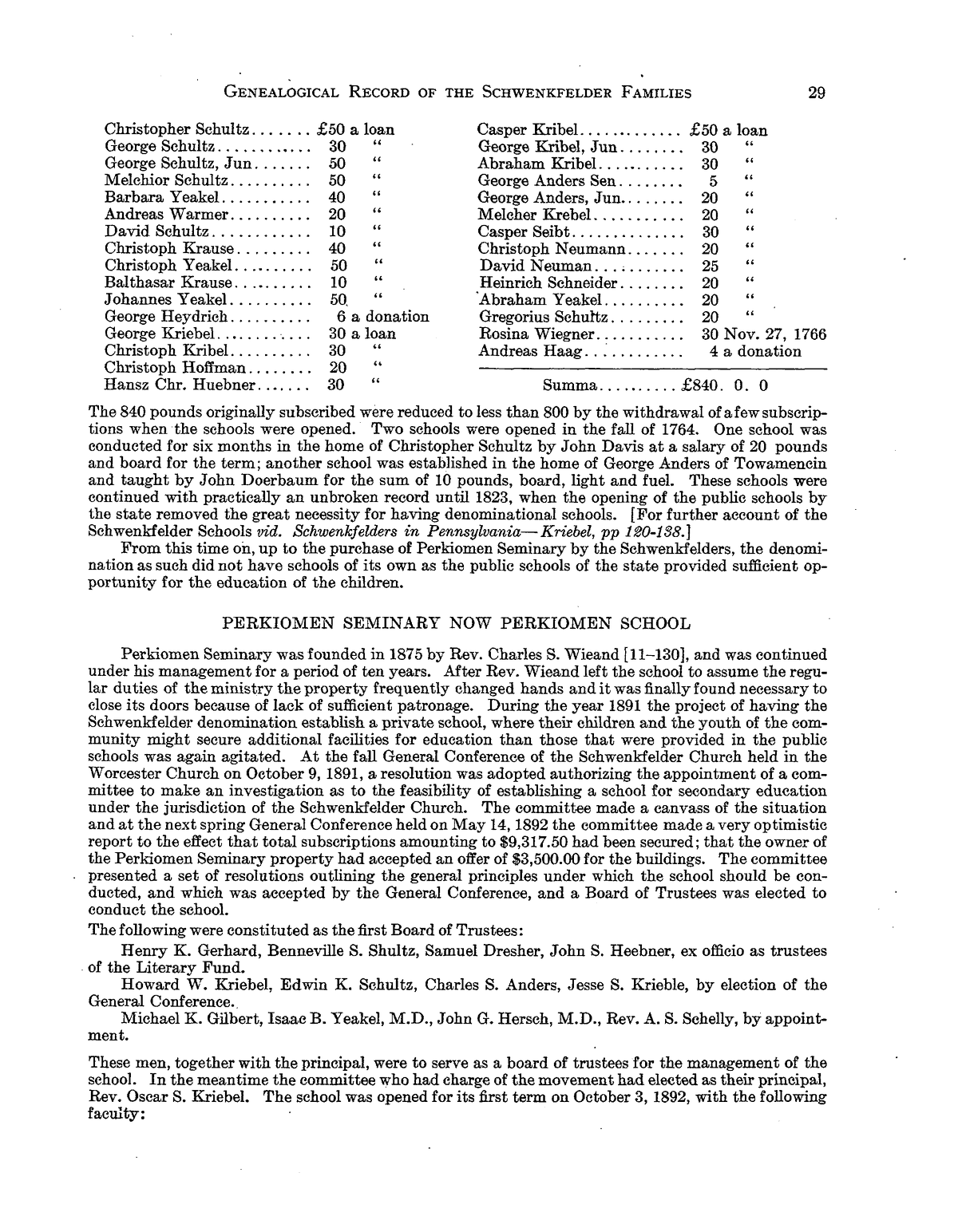
Rev. Osear S. Kriebel, A.M., Principal, teacher of languages and rhetoric.
Rev. E. B. Clemmer, Vice-principal, teacher of history and natural sciences.
Howard W. Kriebel, M. E., teacher of mathematics.
Mrs. Oscar 8. Kriebel, teacher of music.
The General Conference of the Schwenkfelder Church had stipulated that the school should be run for a period of five years, and if at the end of that time there was not sufficient demand for the continua~ tion of the school it was to be abandoned, and after all the debts had been paid the balance was to be
returned to the subscribers. .
The first day showed an enrollment of nineteen pupils, all day students but three. During the first year there was a total enrollment of ninety-six pupils and one graduate. Whereas many doubted the wisdom of opening a school in this vicinity the result of the first year’s work indicated, as was incorporated in a report of the principal, the need for such an institution:
“There is evidently room in the community for a school of advanced standing.”
‘The number of students enrolled, the cheerful words frequently expressed and the attendance at the closing exercises were very encouraging. Few projects that have been brought forth in the neighborhood have received a more hearty endorsement and support by all parties.”
The attendance of the school grew so rapidly that by June, 1895, the trustees, principal, teachers, and pupils all felt so cramped in the very small quarters, that it was necessary to secure enlarged accommodations. The sum of $20,000.00 was subscribed for renovations and for additions to be made to the building. These improvements were accordingly made.and provided for additional aceommodation for more than a hundred students. From the very beginning the school has grown rapidly and has attracted students from all parts of Pennsylvania, from various other states of the union and from a number of foreign countries. In 1902, at the time of the celebration of the tenth anniversary the school had a total enrollment for the year of 302 with a graduating class of 34, and a teaching force of 30 regular teachers. At the celebration of the thirtieth anniversary of the school in June, 1922, it was reported that during the period of its existence the school had a total enrollment of 3,500 students, coming from eighteen different states of the union and thirteen foreign countries. Of its more than 1,200 graduates 800 or more have entered college. Many students have attended higher institutions of learning among which are the best colleges and universities, technical and professional schools in the country. According to statisties recently compiled they have made a record for scholarship and general ability out of all proportion to their numbers. Perkiomen School has honor men, prize winners, and influential leaders in college life in almost every college and university in the country. Practically fifty per cent of the student body enrolled from Perkiomen School is included in the list of honor men and college leaders. A study of the catalog shows that during the last twenty years Perkiomen School has had a higher percentage of students at Princeton University who obtained highest standing in classes, achieved scholarships, and fraternal honors, than any other public high school or secondary school in the United States. The explanation of this record is given in the character of the student body which has an unusually large percentage of able, ambitious, mature, hard working, and enterprising students. This, together with the fact that they are taught in small groups and given personal attention, is given as the explanation of the unsurpassed record made by Perkiomen students in scholarship at the various universities. Ever since its opening Perkiomen School has had an unusually large number of self-supporting students who were obliged to perform manual labor in order to raise funds to secure their education, and who would never have had the opportunity to enter higher institutions of learning had they not been privileged to attend a school of this kind and ascertained that it was possible for young men to go through college and support themselves while doing so. It has always been the aim of the principal, Dr. Kriebel, that Perkiomen School should throw its doors open to any deserving boy or girl who had ambitions for higher education, and the unsurpassed suecess of students who have been given this privilege is sufficient proof that such opportunities are appreciated.
Situated in the beautiful Perkiomen Valley about fifty miles from Philadelphia, the school is ideally located. It is too far away from a large city to have its students diverted from their books by outside attractions. Although Perkiomen Seminary was originally co-educational, a few years ago, following the changes found necessary in all preparatory schools, it was decided to make it a preparatory school for boys and the name was changed to Perkiomen School in September, 1916, so that at the present time there are no boarding girls in the building, although a limited number of girls from the
community attend classes as day students. a
'. The success of Perkiomen School as an educational institution is entirely due to its enthusiastic and optimistic principal, backed by a.loyal board of trustees... Through all the trials and tribulations and difficulties which have accompanied the history of Perkiomen School since its beginning, the op-
See the original page
timism and high ideals set for the institution by its principal have never wavered and, although hereulean obstacles many times presented themselves, they have been successfully overcome. After the close of the World War it was proposed to raise a Victory and Thanksgiving Fund of $150,000.00 in order to cancel the existing deficit of the institution which accumulated during the troublesome war years, and also provide scholarships for the benefit of deserving young men who have no other means of obtaining an education. On Commencement Day, 1922, there was an announcement made that the aggregate amount raised by all interested parties was $109,000.00.
See the original page
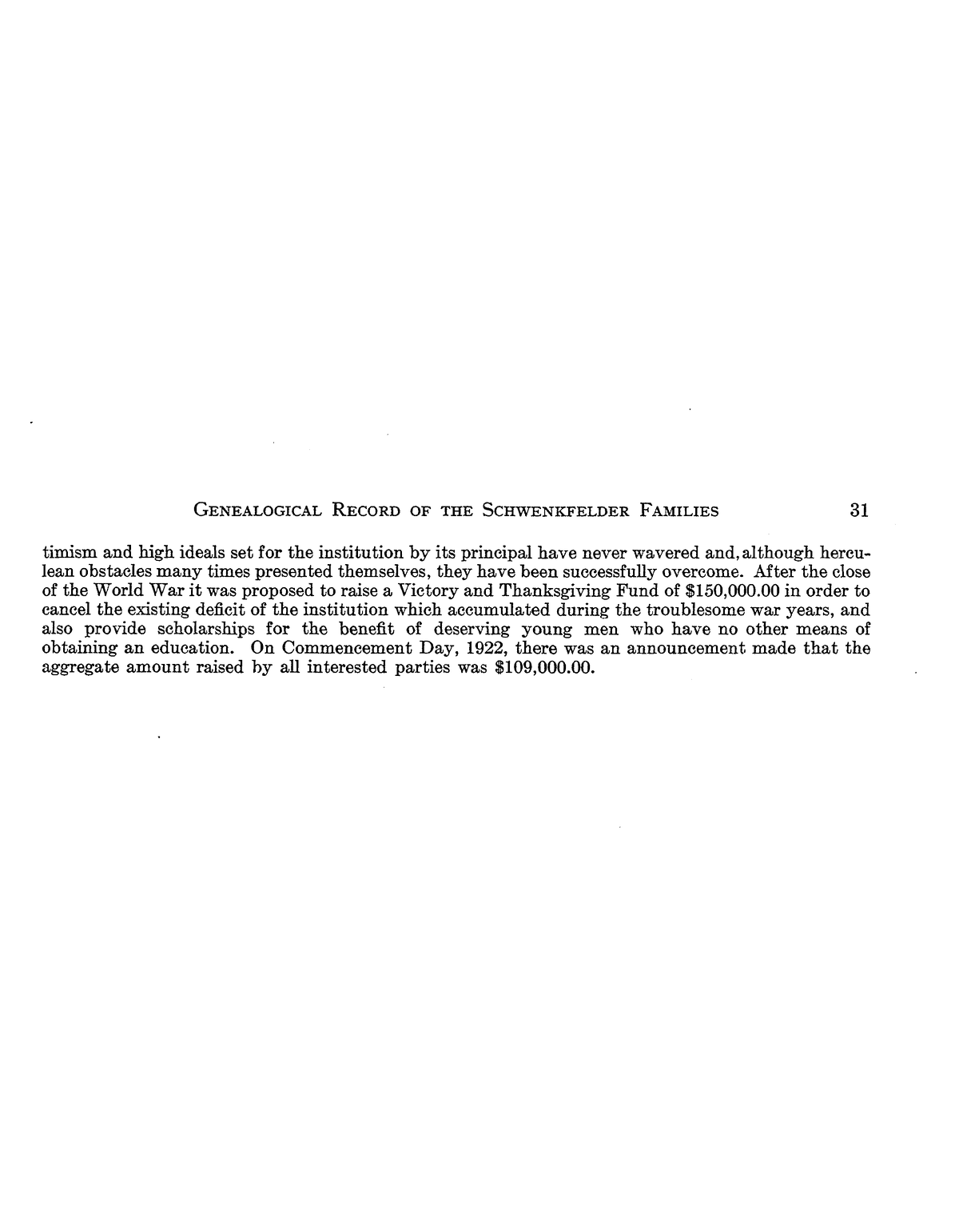
Summary Of Statistics, For The Year 1921, Reported To The
General Conference Of The Schwenkfelder Church,
Held In The Palm Church, Saturday, May 20, 1922.
Districts
Lansdale
                                Philadelphia    Norristown     Palm      Middie    (Mission)      Totals
 Church Membership. ........... :        390         148         274         480          85        1377
 Church Running Expenses.......    $3,569 .38    $1,667.76    $2,380.59    $2,251.05     $764.88   $10,633.66
 Mission Collections. ............       398.93      193 .41      308.16      539.87       41.01     1,481.38
 Charity Fund..................       155.52       88.05       37.17       38.00       15.84      384.58
 Other Objects... ............06.       952.08      313.74      856.12      449 .34       11.80    2,583 .08
 Total Church Collections... ......     5,075.91     2,262.96    3,582.04     3,278.26      833.53    15,032.70
 Legacies or Special Funds .......     2,868.42 ..........     1,521.50     8,625.00 ..........     7,514.92
 Valuation of Church Property....   $10,000.00   $10,000.00   $65,000.00   $22,000.00   $30,000.00 $137,000.00
Sunday Schools
                                                               Schoo         Missionary
     Schools                           Membership            Collections       Collections           Totals
 Philadelphia...........0...00000000-       519                 $829 .82         $140.00           $969.82
 Norristown... 2.0.0.0... . cece eee e eens       286                  452.89            4.42            457.31
 Lansdale.............00 0.00.00. 0005        330                  460.75 .          95.32            556 .07
 Towamencin.. 2.2.2... . cc cee eee       386                  218.39           31.00            249 .39
 Worcester............0.00. 0.0 e ee eee       214                   194.71           40.12            234.83
 Palm...    0.0... eee        347                  762.41          274.00           1,036.41
     Totals. ......0000..0...0.00000.      2082                $2,918.97         $584.86          $3,503 .83
                   Y. PLS. C. E.                                      LADIES’ AID SOCIETY
                             Members’   Collections                                  Members’   Collections
Philadelphia (Senior)............. 90      $87.55      Philadelphia See e cent ee eee ees 85     $515.93
      “      Int      iate)....... 52       40.0         OFristOWN. .. 2...   ee eee eee 40      615.82
      “     a ermedia ®)          12       13 me      Lansdale—Willing Helpers......... 49      172.98
            (Junior).............              -88      Middle District.................. 100      425.05
Norristown (Senior).............. 28       19.51      Palm... 0... 53      411.66
Palm (Senior)....................   79       83.96                                              —_
   ‘sc (Junior) doce ences eececeeeeas 35       22 28        Totals... 2... ee ee eee eee $2,141.44
Middle District...............0.. 113        4.
         weenie                               74.68                     TOTAL COLLECTIONS
  Totals...     0... eee eee e ee eee 409     $341.31      Churches... ..........00eccceeeeeeeees $15,032.70
                                                       Sunday Schools.....................-.    3,503 .83
   ;       ;                                             Ladies’ Aid Societies..................    2,141.44
Philadelphia—Brotherhood........ 20       73.71      Y. P.S. C. E. Societies................      341.31
Philadelphia—Cadet Corps........ 33      759.26      Ome organizations beeen cee e ee ee      898.65
Worcester—Ushers’ League........ 21        6.40       ‘harity Fund account. ................    8,684.04
Worcester—(W. C.T.U.)......... 62       49.17      Literary Fund account.................      533.57
Towamencin—Ushers’ League...... 43       10.11        Totals...     0.2... 0.      ee eee ee $31,135.54
See the original page
The Society Of The Descendants Of The
Schwenkfeldian Exiles
In response to the many inquiries received by the Editor of this book, asking for information concerning the Schwenkfelders, and also asking for information regarding Schwenkfelder history, a movement to organize a society of some kind to record and spread the history of the Schwenkfelders since their arrival in this country, as well as that of their descendants, was started in 1920. As a result of this idea an organization named ‘The Society of the Descendants of the Sehwenkfeldian Exiles’ was organized in Philadelphia on February 8, 1921, with one hundred and twenty-five charter members. The objects of the society are enumerated in the following extracts from the constitution:
Section II. ‘‘The objects of this Society are the preservation of the history of the Schwenkfelder religious exiles, and of their descendants in America, and the promotion of social intercourse among its members now and hereafter.”’
Section III. ‘‘Any loyal American citizen of good character, a descendant through one or both parents, of the Schwenkfelder immigrants who came to Pennsylvania between 1731 and 1737, shall be eligible to membership.”’
So little is generally known of the reasons for the migration of the Schwenkfelders to this country, and the part played by them and their descendants in American development, that the following brief statement is made:
The Schwenkfelders were and still are a Protestant religious sect, founded by Caspar von Schwenckfeld, a Silesian nobleman, who was a contemporary of Martin Luther in the period from 1490 to 1561, and who founded the movement known as the ‘‘Reformation by the Middle Way.’ In 1719, an imperial edict sent two Jesuit priests into Silesia to convert the Schwenkfelders to Catholicism. In 1726 a number of Schwenkfelder families fled to Saxony, taking with them only what possessions they could carry, where they were protected by Count Zinzendorf, the Moravian leader. In 1733 Count Zinzendorf was informed that he could no longer protect them, but that they would be given one year’s time in which to seek a new haven. Declining to accompany Zinzendorf to Georgia, where he planned to found a Moravian Colony, the Schwenkfelders, early in 1734, decided to come to Pennsylvania, where several members of the Schultz family had already located. The main body of the Schwenkfelders. consisting of 184 souls, arrived in Philadelphia September 22, 1734, on the ship Si. Andrew.
Realizing the loss to Silesia by the departure of the Schwenkfelders, in 1742, Frederick the Great, by proclamation, asked them to return, promising restoration of rights and possessions. The Schwenkfelders declined to return.
The motives which led them to emigrate were the desire for religious and personal liberty, and to escape the persecutions which were upon them because of their devotion to these principles. They and their descendants participated in the American War of the Revolution and in all subsequent wars in which America has been involved. They have ever shown a devotion to the country of their adoption, unsurpassed by any other body of pioneers seeking the American shores.
Their history and deeds have not been properly recorded. The Society of “The Descendants of the Schwenkfeldian Exiles’ has been formed to the end that the memory of the original immigrants shall be perpetuated; that their principles and virtues may be better understood, and that the participation by them and their descendants in the development of American ideals and purposes shall be better known, not only to the members of the Society, but also to all other true Americans.
The membership dues of the Society are three dollars per annum in advance. There is no initiation fee. Application for membership should be sent to the
Secretary
Dr. J. E. Burnett Buckenham
Chestnut Hill, Philadelphia, Pa.
Officers Of The
“DESCENDANTS OF THE SCHWENKFELDIAN EXILES”
President, Dr. James M. Anders; First Vice-President, Hon. William Wagener Porter; Second Vice-President, Owen J. Roberts; Seeretary, Dr. J. E. Burnett Bueckenham; Treasurer, Dr. Ralph Getelman. Board of Governors—Charles Heebner, Mrs. A. Conrad Jones, H. Wilson Stahlnecker, Mrs. John Faber Miller, Elmer K. Schultz, Frank M. Underkuffler, Samuel K. Brecht, Henry S. Kriebel, Mrs. Linwood L. Righter. Counsellor, Hon. William Wagener Porter; Physician, Dr. DeForest Porter Willard; Genealogist, Samuel K. Brecht; Committee on Membership—Samuel K. Brecht, Chairman; Charles Heebner, Mrs. John Faber Miller. Committee on Finance— Elmer K. Schultz, Chairman; Dr. Ralph Getelman, Frank M. Underkuffler. Committee on Entertainment—Dr. Ralph Getelman, Chairman; HenryS. Kriebel, Mrs. Linwood L. Righter. Committee on History—Dr., J. E. Burnett Buckenham, Chairman; Samuel K. Brecht, Mrs. A. Conrad Jones.
See the original page