Supplementary History
Supplementary History
By SAMUEL K. BRECHT
In order to answer repeated inquiries as to the history and location as well as the present status of the Schwenkfelder Church, it is deemed necessary to give additional data in this section concerning the ‘later history of the Schwenkfelders as a supplement to that written by Judge Heydrick on the preceding pages. When the attempt was made in Saxony to force the Schwenkfelders to return to Silesia, as narrated by Judge Heydrick, they did not all flee to America as will be described in connection with the families in later pages. In consequence of the migration to Pennsylvania, families were broken up; in. some cases husbands were parted from wives; children from parents, brothers and sisters from each other.
It has been impossible to obtain actual statistics of the number ot Sehwenkfelders who remained in Europe, but it is known that a number of them returned to Saxony, and it is stated by some that at least five hundred souls were under the jurisdiction of Count Zinzendorf when he was notified that they would no longer be tolerated in Lusatia.
Number Of Schwenkfelders
In a reply to a questionnaire of the Saxon government at a request from the King of Poland regarding the number of Schwenkfelders in Saxony at that time (1732), it was stated that 179 persons had fied to Saxony, that twenty-five families remained, and twenty individuals went over to the Evangelical religion between 1722 and 1732. They had been tolerated in Silesia for 200 years. [Dresden Staats Archiv. |
From the letters written to the Mennonites by Adam Wiegner, the secretary of the Schwenkfelders during this pre-migratory period, we learn that there was much opposition within the body towards their migration to Pennsylvania. The Emperor of Germany invited them to settle in the province of Brandenburg, near Berlin, where he agreed to erect linen factories for them so that they might find employment there. Count Zinzendorf, indeed, persuaded them to agree to go with him with a body of Moravians to found a colony in Georgia, which they agreed to do under certain conditions. When the time for departure was at hand the Count could..not meet his conditions, so the Sechwenkfelders felt they were no longer bound by their agreement, which was never put in writing, and they decided to come to Pennsylvania. Hence, it. seems that the hand of Providence was the guiding star that kept them from locating in Brandenburg or being transported to Georgia to become slave owners.
The various migrations are described in the following chapters, but apparently a very large number remained in Germany and were assimilated with the other denominations. The passport of Frederick Bormann reproduced on another page is a proof that some of the families returned to Silesia. The letters in Christopher Kriebel’s letter book (vid. Christopher Kriebel [19-2]) give us a glimpse of the condition in Silesia during this period subsequent to the migration to Pennsylvania. The last surviving Schwenkfelder in Silesia as given by Kadelbach seems to have been Melchior Dorn, who died in Harpersdorf in 1726. His arm chair reposes in the Schwenkfelder Historical Library at Pennsburg, Pa. The descendants of Melchior Dorn living in Germany today state that Mr. Dorn always claimed to his dying day that he was a steadfast Schwenkfelder.
Only forty families decided to migrate to Pennsylvania. The rest remained in Gérlitz, went over to the Lutheran Chureh, bought homesteads and married. The forty glaubenstreue (faithful) families departed in January, 1734, from Gérlitz and the surroundings for England, whence through their Haarlem friends shipped for Pennsylvania on July 29,1734, and under God’s protection landed Sept. 22,1734.
On June 18, 1732, in response to a request for the number of Schwenkfelders in Gérlitz, Dr. Christopher Biittner reported that in Gorlitz were the following:
i. Adam Wiegner with wife and four children.
2. David Lips and wife.
3. Melchior Hiibner and four children.
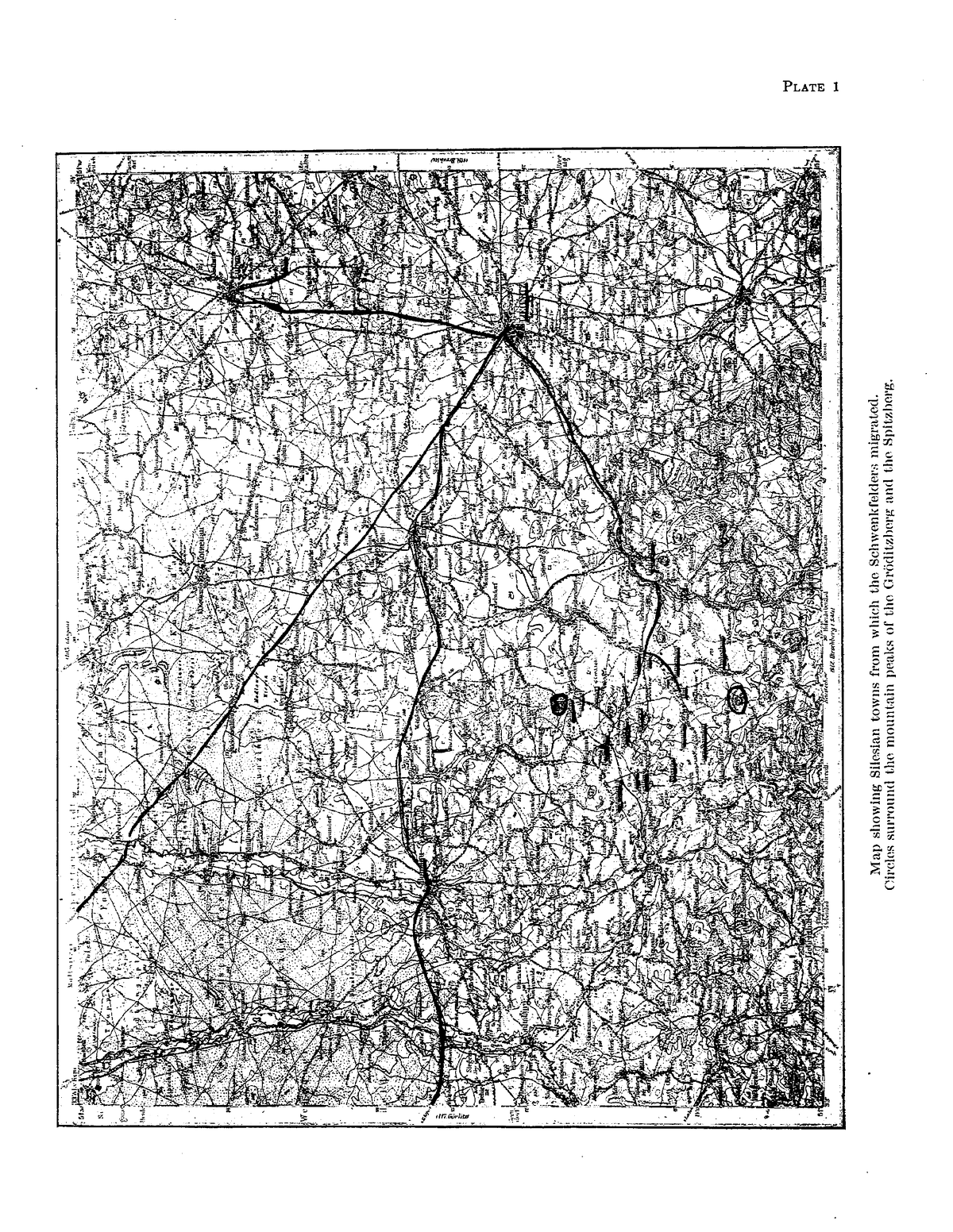
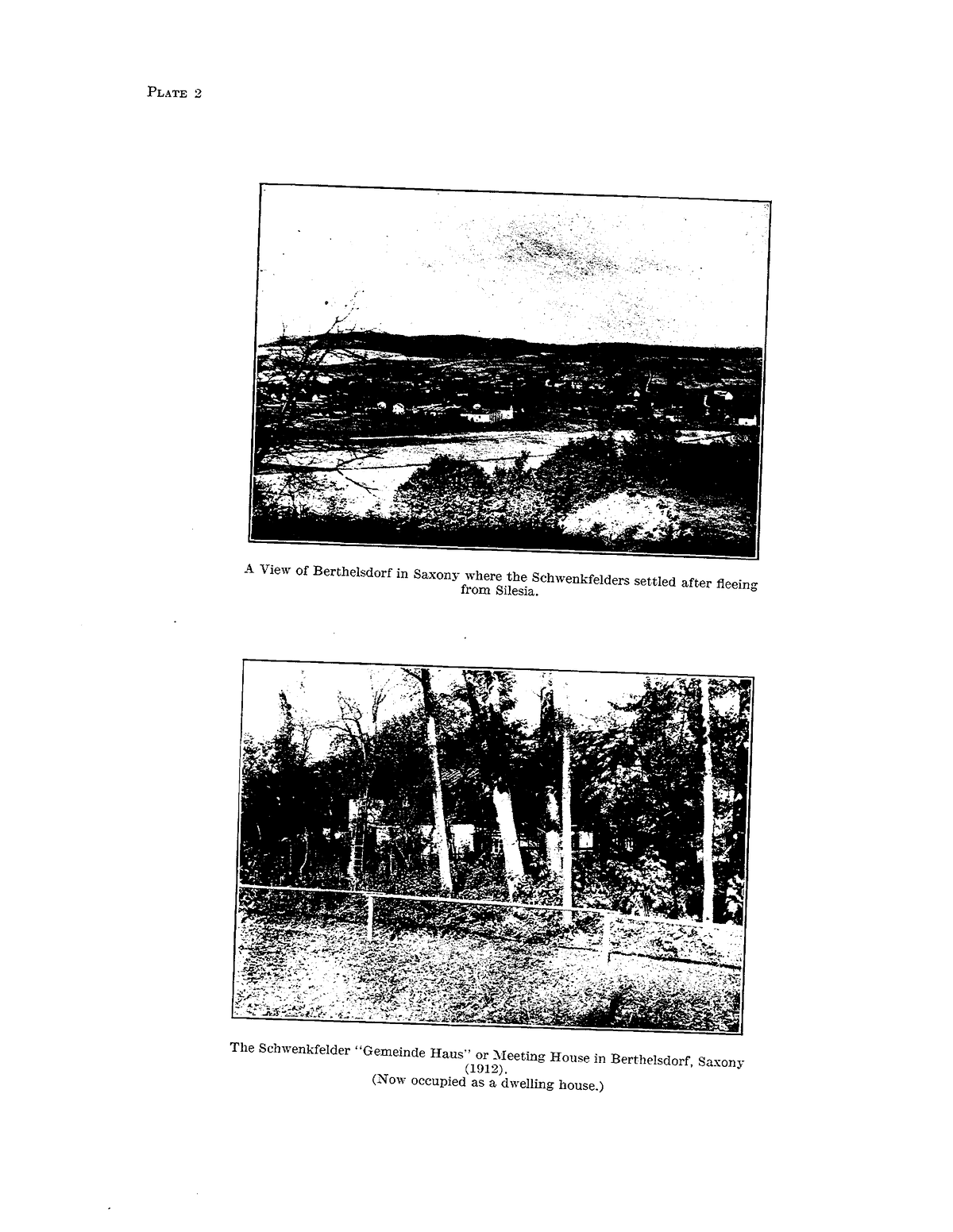
In Hennersdorf, Melchior Krause ‘‘ein Dorfschneider” (village tailor). They were quiet people and disturbed no one, so that no one could complain about them. All the remainder had gone to Berthelsdorf.
On May 13, 1734, Christopher Wiegner and Melchior Hiibner thanked the magistrate for his protection thus far, and asked for a passport to America.
See the original page
In 1734, after most of the Schwenkfelders had migrated from Upper Lusatia, from 20 to 28 persons, men and women, came from out of Silesia to Gérlitz. They found quarters with M. Schéfer “im Hinterhause,” and a few burgers. They were sent out of Berthelsdorf to Gérlitz. While they fled on account of force, many more became Catholics. They requested domiciles for only three months. In this group was Caspar Teichman with a family of seven, and Kaspar Bormann and Melchior Schubert with his family.
On Apr. 27, 1736, there came out of Harpersdorf Abraham Beyer with wife and five children, and two other families. They were bound for Gorlitz. It was proposed to them that they join the Evangelical Church (Lutheran), but they remained only a short time. [ Kadelbach, p 65.|
The Migration To Gorlitz
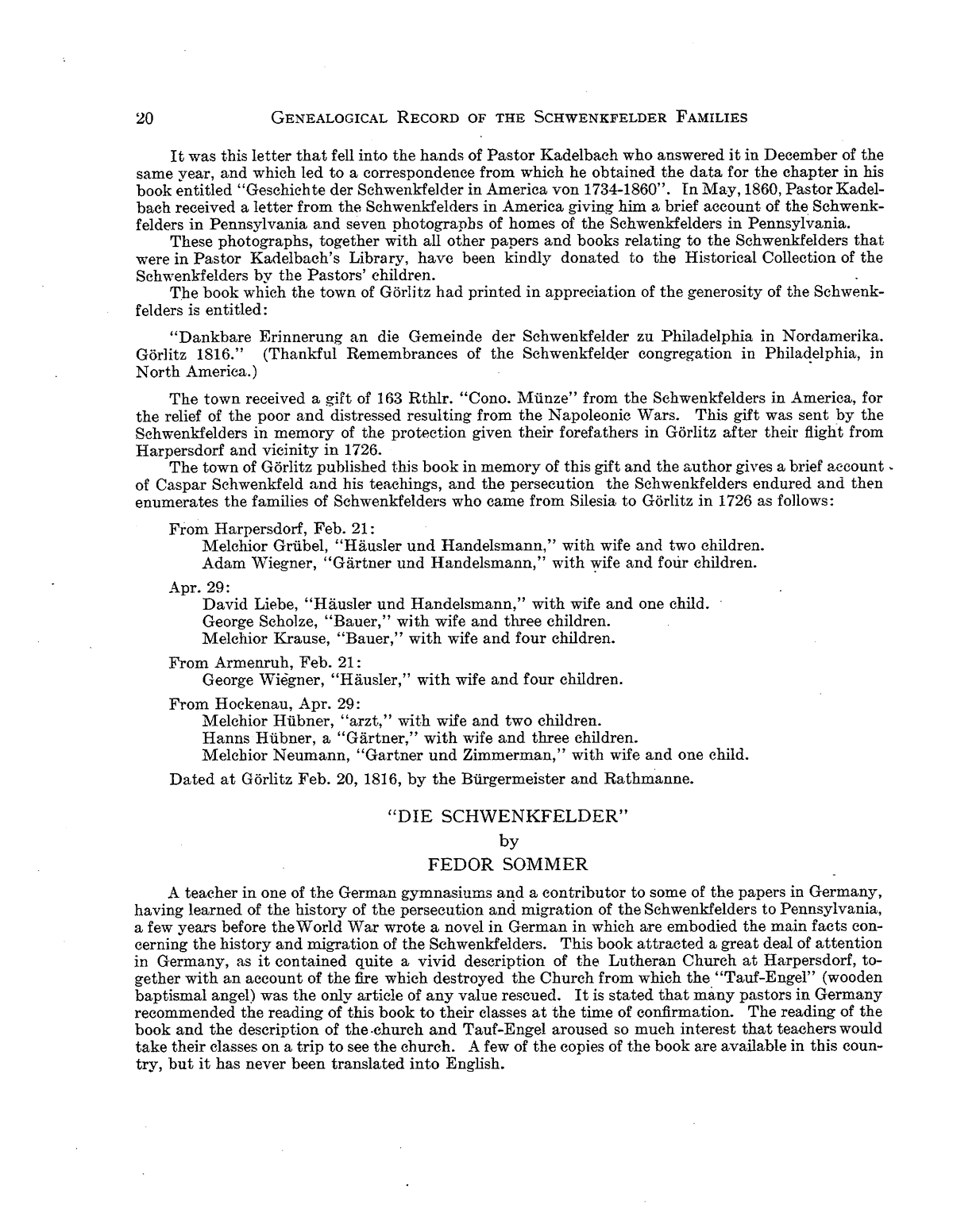
In the 17th and 18th centuries, Gérlitz was of all the towns in Upper Lusatia the chief home of the Schwenkfelders. Sebastian Schiitze, owner of the villages of Leopoldshein (Leutpoldshayn) and Hennersdorf, a scientific and cultured man, is said to have been the first Schwenkfelder in Gorlitz. He was already married in 1512, and was such an ardent follower of Protestantism that he organized divine services in the home for his children and household. In 1544, he had a converted shoemaker from Gérlitz, named Franz Seidel, installed as pastor at Leopoldshein and had him ordained as pastor. {| Kadelbach, p 58.]
The following is a list of Sechwenkfelders who came to Gorlitz, according to Kadelbach:
Feb. 21, 1726: from Harpersdorf, Melchior Kriebel, “‘Hausler und Handelsmann,” with family; Adam Wiegner, “Gartner und Handelsmann,” with wife and four children.
Apr. 29: David Liebe, ““Handelsmann,”’ with wife and one child.
From Armenruh, Feb. 21, 1726: George Wiegner. with wife and four children.
From Hockenau, Apr. 29, 1726: Melcl..: Hiibner, “‘Arzt,”’ with wife and three children. Melehior Neumann, “Zimmerman,” with wife and child.
From Harpersdorf to Hennersdorf, near Gorlitz, Apr. 29, 1726: George Scholtz, “Bauer,” with wife and three children. Melchior Krause with wife and four children.
From Harpersdorf to Berthelsdorf, under Count Zinzendorf, Feb. 16, 1726: Balthasar Jackel, “Bauer,” with wife and five children. Melchior Meschter, “Schumacher,” with wife and three children. George Hoffman, ‘‘Hausler,” with wife and four children. George Reinwald, ““Hausler,” with wife and three children.
Apr. 30: Balthasar Schultze, ‘““Bauer,” with wife and five children.
May 1: Christoph Kriebel, “Bauer,’’ with wife and three children; Melchior Scholz, ‘‘Bauer,”’ with wife and three children; Melchior Kriebel; Balthasar Heidrich u And.
From Armenruh, Feb. 28: Georg Anders, ‘““Weber,” with wife.
From Harpersdorf to Herrnhut, May 5, 1726: George Weiss, “Weber” and wife.
Balthasar Hoffman (he spent five years as ambassador of the Schwenkfelders at the Imperial: Court), with wife and two children. Christopher Hoffman, with wife, also an ambassador.
All together there were 170 persons who left the above named, Places and came to Gérlitz and settled in the surrounding community.
They found a good friend and counsellor in Gérlitz, Senator and merchant Hanisch, who wrote to friends in Holland in their behalf and secured aid for them. In a reply from Isaac Grajestein from Haarlem, dated May 10, 1726, amongst other things he says they have raised 6000 Holland gldr. for the benefit of the Schwenkfelders, and that Senator Hanisch might draw personally on him for 1000 gidr. and distribute it amongst the needy. [Kadelbach, pp 47-76.] ~
The last Sehwenkfelder who came to Gérlitz from Harpersdorf arrived December 14, 1740. She was the twenty-four-year-old widow Anna Rosina Wagner, née Hiibner. She had a child one and threefourths years old. She was asked whether she wished to become protestant (evangelical). She answered evasively—she would not forbid her child to become Lutheran but as for herself, she could not yet decide. From this time on the migration of the Schwenkfelders towards Upper Lusatia ceased, as Frederick the Great had granted religious toleration in Silesia. [ Kadelbach, p 66.)
The small group of Schwenkfelders remaining in Silesia in respect to their belief and attitude bore the persecution better than their freedom. For soon after they obtained freedom of belief they began to seek associations, their clothing became modernized, and they had less respect for the sanctity of the Sabbath. Thus it happened that year after year the number decreased and the freedom of the ranks lightened. Most of their children decided to declare for Protestantism and to participate in all (rights) practices of the denomination. [Kadelbach, p 50.]
See the original page
The last Schwenkfelder in Lower Silesia who still declared himself to be so openly, was the (Bauer, guts-besitzer) farm owner, Melchior Dorn of Harpersdorf. He died June 24, 1826, aged 73 years, 9 months, and 8 days. Thus for 100 years after their dispersal there remained Schwenkfelders in Silesia. The Catholic Chapel in Harpersdorf still standing on the fine Meschter farm and built by the Catholics with the fines paid by the Schwenkfelders for not attending chureh, and the graves in the Viehweg are the last and only monuments in Silesia of the persecution of the Schwenkfelders.
The Viehweg At Harpersdorf
The Viehweg is a public burying ground or ‘‘Potter’s Field’’ located in Harpersdorf, Silesia, in which Schwenkfelders who were denied Christian burial in the church cemeteries were interred. It was considered a very great disgrace to be interred there, as it was supposed to be the burial place of criminals who were interred there ofttimes by public decree only. On May 17, 1704, Sybilla Adolph, who had taken the life of her infant babe by drowning it in a neighboring pond, was beheaded and buried there. Another official document states that a woman who had taken her own life by hanging, on the premises of Adam Meschter, in Upper Harpersdorf on May 24, 1715, was buried in the Viehweg by special decree; hence burial in the Viehweg was intended not only as a curse to the parents, but also to the children of those who were buried there.
Between the years 1720 and 1741, more than two hundred Schwenkfelders were buried in this plot. After the Jesuit Mission had come to Harpersdorf the last Schwenkfelder to be buried in the churchyard was Eva Schultz, on Nov. 3, 1722, and the first one to be buried in the churehyard after the struggle was over was George Groh who died Oct. 27, 1741, at the age of 86. All the Schwenkfelders dying between these dates were forbidden burial in the churchyards, thus this spot is sacred to the Sechwenkfelders because of its history.
The early documents of the Schwenkfelders, written during the persecution and after themigration, mention the burials in this plot, and we find that Rev. Christopher Schultz in 1772, in a letter to C. E. Heintze, has a long discussion regarding the Viehweg, and expresses the hope that the Sechwenkfelders might secure this property, convert it into a graveyard with a proper enclosure, and erect on it a monument or a Denkmal. We also find that Rev. Oswald Kadelbach, a great friend of the Schwenkfelders, was desirous that desecration of this holy ground should be prevented, as he stated that this Viehweg was considered public property. It was used as a dump and anyone needing loads of soil or dirt to fill up holes in his premises would come to this graveyard and help himself. This was carried on to such an extent that in some places the bones of the dead were uncovered and exposed. Conditions remained the same until 1861, when Dr. Solomon S. Schultz, who was visiting the hospitals of Europe in preparation for becoming superintendent of the State Hospital at Danville, Pa., paid a visit to Silesia, met Pastor Kadelbach, and visited this graveyard. As a result of this visit Dr. Schultz communicated with his friends in America, a fund was raised, the ground was purchased by the Sechwenkfelders, and a hand- . some monument has been erected upon it. This monument contains the following inscription:
                “Hier ruhen in Gott                     “Die Liebe der Nachkomen
                 die glaubenstreuen                           in Nord-Amerika
               Schwenkfelder welche in                  setzte den Voreltern zu Probst
               den Jahren 1720-40 auf                    hayn, Harpersdorf, Langen
              diesem Viehwege beerdigt                    neundorf u. Lauterseifen
                      wurden.”                                dieses Denkmal
1863.”
[TRANSLATION]
‘Here rest in God the faithful Schwenkfelders who were buried in this Viehweg between 1720 and 1740.” On the other side of the monument is this inscription: ‘“The descendants in North America erected this monument in memory of their ancestors in Probsthayn, Harpersdorf, Langenneundorf, and Lauterseifen.”’
The monument stands in the center of the plot, which is overgrown with white birch trees, so that the cemetery is practically a grove.
Dr. Schultz had also planned to enclose this burial ground by a stone wall, but the funds collected not being sufficient to erect both the wall and the monument, the monument was erected first and the erection of the stone wall has never taken place. The breaking out of the Civil War required the services of Dr. Schultz as surgeon in the army, thus taking his time and attention from these matters, and the high rate of foreign exchange also militated against forwarding any more money to Germany for
See the original page
completing the plans proposed for the Viehweg. In the course of time Pastor Kadelbach died, and there being no one in Germany to look after the matter, the grounds have remained unenclosed to this day.
Prior to the late World War the Schwenkfelder Church for a number of years had sent funds to Harpersdorf to pay for the upkeep of the cemetery, but since the breaking out of the war nothing further has been done towards providing for its maintenance. [Vid. Schwenkfeldian, Vol. III; p 42.]
Burning Of The Church At Harpersdorf
The Jesuit Milahn lived in Harpersdorf in a narrow farm house in the upper part of the village, and was always pleased to have friends and patrons visit him during his spare hours.
On one of these occasions it seems that a large quantity of refreshments was crowded into the narrow house in order to entertain those present. In October, 1726, it happened that a large number of guests had assembled in the priest’s house and at this time his relations with the Schwenkfelders still remaining in Harpersdorf was not very cordial. Pains were taken to give the guests good entertainment, but the narrowness of the rooms was not taken into account, so that fire broke out and raged with such fury that in less than four hours four farm houses and twenty other country dwellings, besides the handsome protestant church with the tower and chimes were a prey to the flames. [It is stated that the only part of the church not destroyed was the ‘‘Tauf-Engel” which is preserved in the present Lutheran Church in Harpersdorf, said to be the only Tauf-Engel in the whole of Silesia.—Editor. ]
No one dared to make open charges regarding the fire, but the murmurings of the members of the unfortunate congregation, as well as those outside could not be restrained. Father Milahn no longer feeling secure in his berth had himself recalled from Harpersdorf in order to escape punishment at the hands of the village folk. After recovering from the shock of the fire the protestant congregation immediately set out to rebuild the church and tower that had been destroyed.
Pastor Neander, who had for a long time been hated by the Jesuits, as was his duty, took this opportunity and demanded among other things that, at the wish of the community, a third bell or chimes be purchased for the church. This demand aroused the Jesuits against him anew. They complained to Vienna that Neander had violated the consistorial command that no radical changes should be made to any church edifice, whereas he ordered a third bell for the church. The result was that an imperial decree was issued-suspending Neander from the service. [ Kadelbach.|
Schwenkfelder Gratitude
The Schwenkfelders at different times sent letters and money to Europe.
In 1771 and 1772 they wrote to Harpersdorf and Probsthayn to ascertain whether any of their fellow believers were in need, and if so they would forward money for their support.
In 1816 they sent a considerable sum (167 Rix dollars) to the Council at Gorlitz as a thank-offering in remembrance of the favors and protection given their ancestors. The money was to be used for the relief of unfortunate Lusatians who were left destitute as a result of the war, or for the relief of any destitute Schwenkfelders who lived in Lusatia. The Council of Gérlitz thanked the Schwenkfelders in an official manner [vid. letter of Gérlitz plate], and Scabinus Zahne wrote an historical account of the trials of the Schwenkfelders in Gérlitz which was printed and sent to the Schwenkfelders in America [vid. Dankbare Erinnerung an die Gemeinde der Schwenkfelder zu Philadelphia, Gérlttz 1816]. After the author’s death in 1819, his widow received a letter from America dated Montgomery County, Pennsylvania, Sept. 7, 1818, written by Christoph Jackel, Chairman. In this letter thanks are given for the impartial accounts which the Schwenkfelders received concerning conditions about Gorlitz, and enclosed was a copy of the “Erlduterung ftir Herrn Casper Schwenckfeld.”
In November, 1857, a letter signed by George Meschter, William Schultz and Jacob Meschter was addressed to the ‘““Burgermeister Arnt in Probsthain.” This letter recites that the Schwenkfelder congregation was desirous of ascertaining whether any Schwenkfelders are still living in Probsthain and vicinity. The letter recites the fact that in 1771 and 1772 a correspondence between the Schwenkfelders in Pennsylvania and those in Probsthain had been carried on [| Heintze Correspondence], and it was hoped that some still existed in Silesia. The writers of the letter offered to pay whatever cost would be entailed to give this information, and enclosed one dollar to pay the expenses of this letter and the reply. The reply to this letter was to be sent to
“Mr. Moritz Loeb
Editor of the Morgenstein, Deylestown, Bueks Co., Pa., U. S. A.”
See the original page
It was this letter that fell into the hands of Pastor Kadelbach who answered it in December of the same year, and which led to a correspondence from which he obtained the data for the chapter in his book entitled ‘‘Geschichte der Schwenkfelder in America von 1734-1860”. In May, 1860, Pastor Kadelbach received a letter from the Schwenkfelders in America giving him a brief account of the Schwenkfelders in Pennsylvania and seven photographs of homes of the Schwenkfelders in Pennsylvania.
These photographs, together with all other papers and books relating to the Schwenkfelders that were in Pastor Kadelbach’s Library, have been kindly donated to the Historical Collection of the Schwenkfelders by the Pastors’ children.
The book which the town of Gorlitz had printed in appreciation of the generosity of the Schwenkfelders is entitled:
“Dankbare Erinnerung an die Gemeinde der Schwenkfelder zu Philadelphia in Nordamerika. Gérlitz 1816." (Thankful Remembrances of the Schwenkfelder congregation in Philadelphia, in North America.)
The town received a gift of 163 Rthlr. ““Cono. Miinze’’ from the Schwenkfelders in America, for the relief of the poor and distressed resulting from the Napoleonic Wars. This gift was sent by the Schwenkfelders in memory of the protection given their forefathers in Gérlitz after their flight from Harpersdorf and vicinity in 1726.
The town of Gorlitz published this book in memory of this gift and the author gives a brief account - of Caspar Schwenkfeld and his teachings, and the persecution the Schwenkfelders endured and then enumerates the families of Schwenkfelders who came from Silesia to Gérlitz in 1726 as follows:
From Harpersdorf, Feb. 21:
Melchior Griibel, ‘‘Hausler und Handelsmann,”’ with wife and two children.
Adam Wiegner, ‘Gartner und Handelsmann,” with wife and four children.
Apr. 29:
David Liebe, ‘‘Hiusler und Handelsmann,” with wife and one child. ©
George Scholze, ‘“‘Bauer,”’ with wife and three children.
Melchior Krause, ““Bauer,’’ with wife and four children.
From Armenruh, Feb. 21:
George Wiegner, ‘““Hausler,’”’ with wife and four children.
From Hockenau, Apr. 29:
Melchior Hiibner, ‘‘arzt,’’ with wife and two children.
Hanns Hiibner, a “Gartner,” with wife and three children.
Melchior Neumann, “‘“Gartner und Zimmerman,” with wife and one child.
Dated at Gérlitz Feb. 20, 1816, by the Biirgermeister and Rathmanne.
“DIE SCHWENKFELDER”
by
Fedor Sommer
A teacher in one of the German gymnasiums and a contributor to some of the papers in Germany, having learned of the history of the persecution and migration of the Schwenkfelders to Pennsylvania, a few years before the World War wrote a novel in German in which are embodied the main facets concerning the history and migration of the Schwenkfelders. This book attracted a great deal of attention in Germany, as it contained quite a vivid description of the Lutheran Church at Harpersdorf, together with an account of the fire which destroyed the Church from which the ‘“Tauf-Engel”’ (wooden baptismal angel) was the only article of any value rescued. It is stated that many pastors in Germany recommended the reading of this book to their classes at the time of confirmation. The reading of the book and the description of the-church and Tauf-Engel aroused so much interest that teachers would take their classes on a trip to see the church. A few of the copies of the book are available in this country, but it has never been translated into English.
See the original page