Explanations and Abbreviations
Explanations And Abbreviations
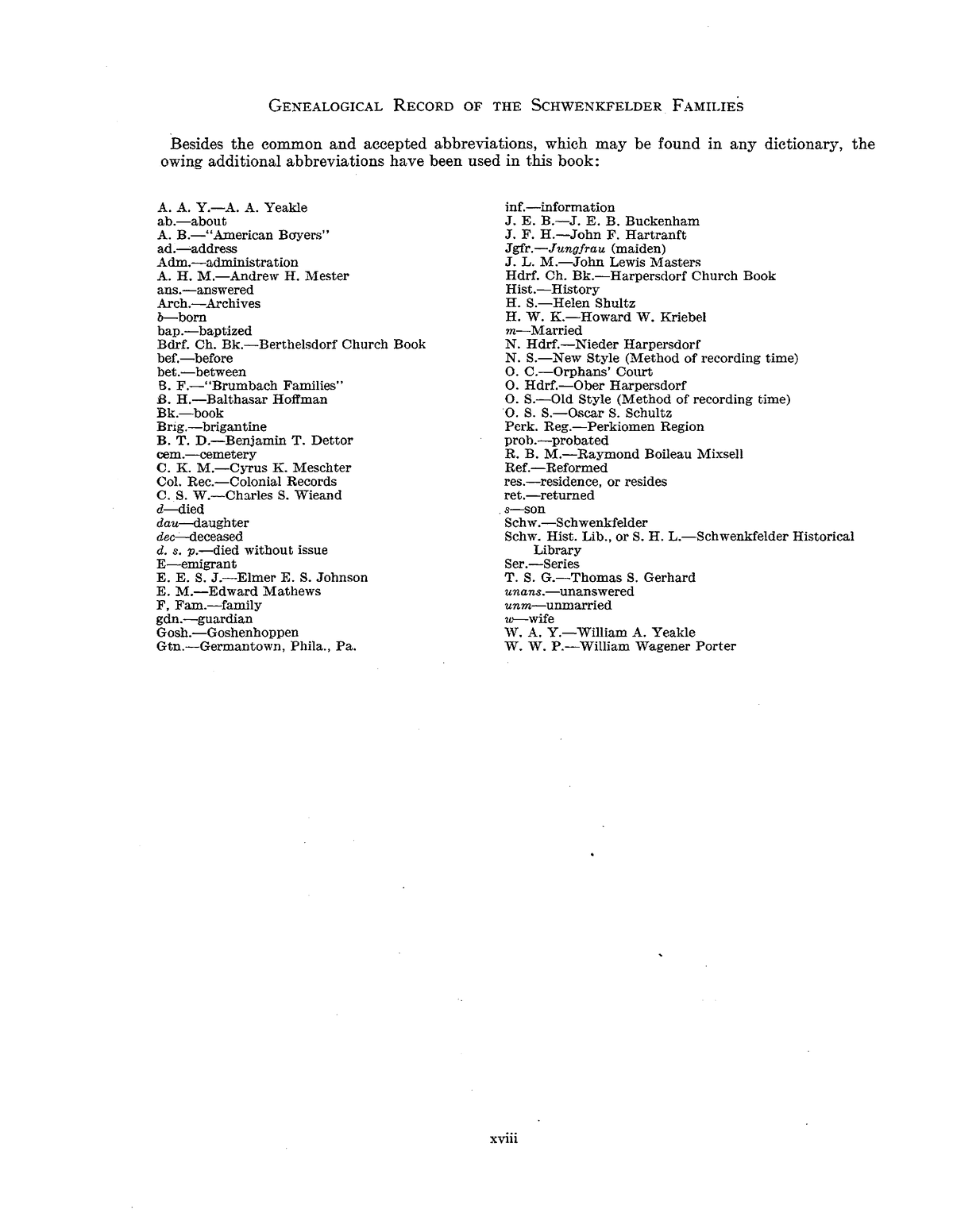
Throughout this genealogy a system of family-numbering has been employed by means of which the line of descent of every family can be traced together with the respective immigrant Schwenkfelder ancestor of each one.
All emigrants have been numbered consecutively: thus, Melchior Kriebel is number “25” on the emigrant list, and henee the family number ‘‘[25]” has been assigned to him. Furthermore, all the married male descendants of Melchior Kriebel will have the key number “25” preceding their own individual family number: for example, the family number of David Kriebel is “‘[25—5],”” which means that he is descended from emigrant ‘‘25,” who is Melchior Kriebel, and that the David Kriebel family is the fifth family recorded in line of descent from Melchior Kriebel. When a descendant marries more than once, there is a family number for each marriage: David Kriebel married twice, and hence his first family record has the number ‘‘{[25-5a],”’ while the number “‘[25—5b]” is assigned to the family of his second marriage. This likewise applies to several emigrants: Balzer Heydrick, who was emigrant ‘‘52,’’ was married twice, and therefore has the two family numbers of ‘‘[52a]” and ‘[52b].”
In the case of the marriage of a female descendant, her family takes the family number of her husband, providing the latter is himself of Schwenkfelder origin. For example, Susanna Kriebel, a daughter of George Kriebel whose family is “[25-3], ’? married Christopher Yeakle, a Schwenkfelder descendant; the family number, therefore, that is assigned to Susanna Kriebel Yeakle is that of her husband, or “{160-3].”
However, when a female descendant marries a man who is not of Schwenkfelder blood, she retains _her own emigrant ancestral number, just as the male descendant does. Thus, Anna Schultz, a daughter of Melchior Schultz whose family is ‘‘{7~2],”” married Adam Hillegass, who was a non-Schwenkfelder; her family number therefore is ‘[7-9].”’
’ All numbers preceded by the capital letter ‘‘E’’ are emigrant numbers and will be found only after the name of an emigrant. Numbers preceding a name are in all eases Family numbers: for
example, ‘]25-3] GEORGE KRIEBEL [E99], . . . . s Caspar and Susanna (Wiegner)
Kriebel [25-1] means that the individual number of the George Kriebel: family is ‘[25-3]’’; that George Kriebel himself was the ninety-ninth emigrant on the list; and that the number of his parents’ family is [25-1], by reference to which record all genealogical facts eoncerning his father, mother, brothers and sisters can be ascertained.
After the family groups had all been numbered a large amount of additional information was obtained concerning some of the families. In order to include this data and have the families inserted in their proper sequence, the system of decimal numbers was introduced; for example, “‘(21~-332.4]” is the number assigned to the record of John Hoffman.
The reader will observe that married children only have family numbers in this book, as the scheme employed is one of family numbering instead of the usual method of numbering each child in a family. By this plan of numbering the reader may readily trace the ancestry of any Schwenkfelder descendant in the book. Furthermore, at the end of the book will be found the index in which the names of all parents and children recorded in the book are listed together with the page on which they appear.
Upon a eursory glance through the genealogical part of the book, the reader will discover that one or both of the names of the parents of a family have been set in bold-face capital letters. This device is employed to designate the parents of Schwenkfelder origin, while light-face capital letters have been used to show the name of the parent of non-Schwenkfelder descent. Thus at a glance the reader can tell whether the heads of a family are both Schwenkfelder descendants or not.
It may be well to explain also that the genealogy has been arranged in ‘“‘chapters”’; for instanee, all families having the key number ‘‘[25]’’ follow in order after the emigrant family whose number is “125],”’ or that of Melchior Kriebel. And the chapters themselves are arranged in order according to the family number of the respective emigrant heads—the one with the lowest number appearing first in the book.
In the ease of varying dates, both are given with one of them enclosed in parentheses; when there is doubt as to a date, a question mark, enclosed in parentheses, follows the date.
xvii
See the original page
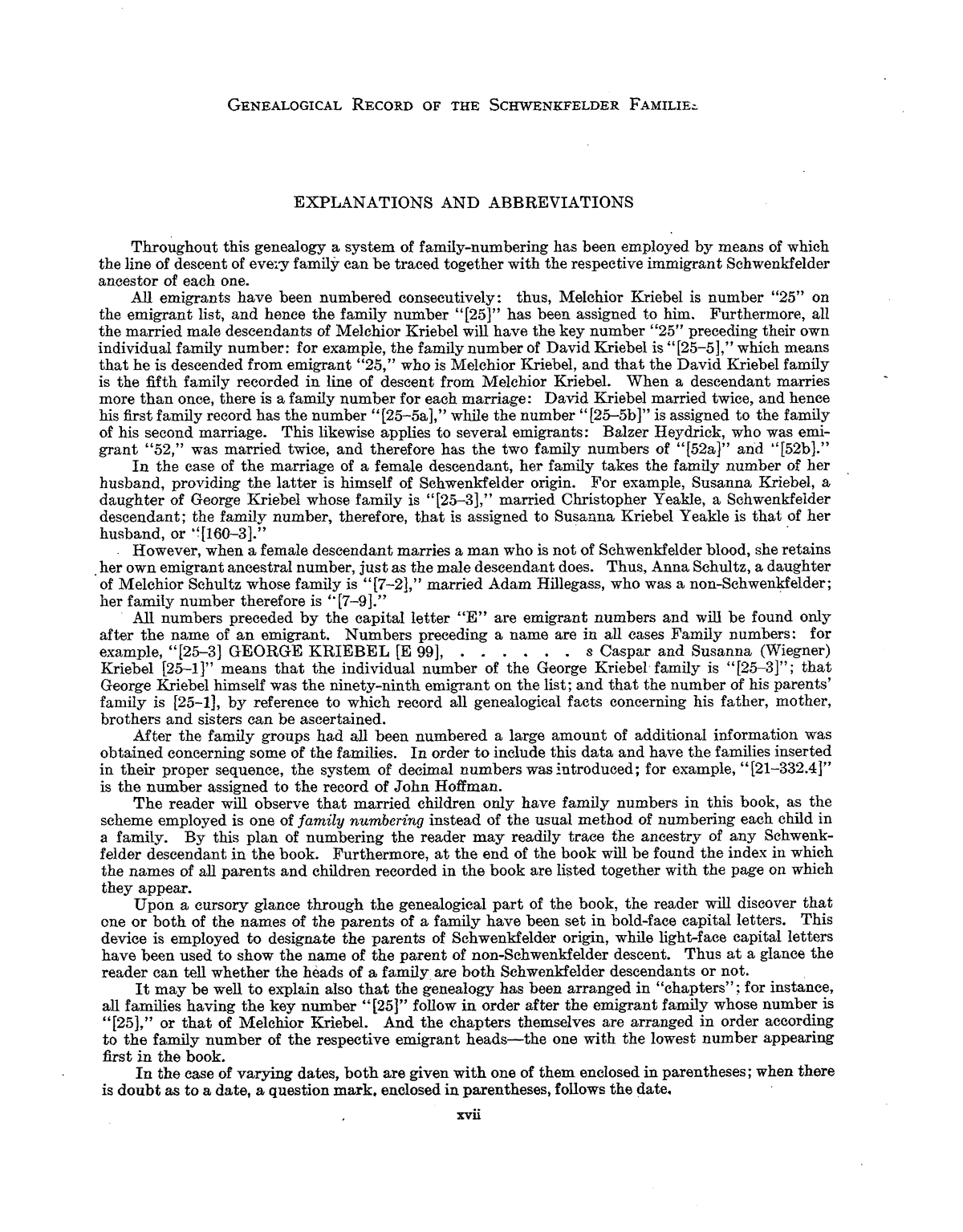
Besides the common and accepted abbreviations, which may be found in any dictionary, the owing additional abbreviations have been used in this book:
A. A, Y.—A. A. Yeakle                           inf.— information
ab.—about                                      J. E. B.—J. E. B. Buckenham
A. B.—‘‘American Boyers’”’                        J. F. H.—John F. Hartranft
ad.—address                                    Jgfr.—Jungfrau (maiden)
Adm,.—administration                            J. L. M.—John Lewis Masters
A. H, M.—Andrew H. Mester                     Hadrf. Ch. Bk.—Harpersdorf Church Book
ans.—answered                                  Hist.— History
Arch.—Archives                                 H. S.—Helen Shultz
6—born                                        H. W. K.—Howard W. Kriebel
bap.—baptized                                  m—Married
Bdrf. Ch. Bk.—-Berthelsdorf Church Book           N. Hdrf.—Nieder Harpersdorf
bef.—before                                     N. S8.—New Style (Method of recording time)
bet.— between                                   O. C.—Orphans’ Court
B. F.—“‘Brumbach Families”                      Q. Hdrf.—Ober Harpersdorf
8B. H.—Balthasar Hoffman                        O. 8.—Old Style (Method of recording time)
Bk.—book                                      ‘O. 8. S— Oscar 8. Schultz
Brig.—brigantine                                Perk. Reg.—Perkiomen Region
B. T. D.—Benjamin T. Dettor                 ‘    prob.—probated
cem.—cemetery                                  R. B. M.—Raymond Boileau Mixsell
Cc. K. M.—Cyrus K. Meschter                     Ref.— Reformed
Col. Rec.—Colonial Records                       res.—residence, or resides
Cc. 8. W.—Charles 8S. Wieand                      ret.—returned
d—died                                        _s—son
dau—daughter                                   Schw.—Schwenkfelder
dec—deceased                                   Schw. Hist. Lib., or 8S. H. L.—Schwenkfelder Historical
d. s. p.—died without issue                            Library
E—emigrant                                    Ser.—Series
E. E. 8. J.—Elmer E. 8. Johnson                  T. 8S. G.—Thomas 8. Gerhard
E. M.—Edward Mathews                         unans.—unanswered
F, Fam.—family                                 unm—unmarried
gdn.—guardian                                  w—wife
Gosh.—Goshenhoppen                            W. A. Y.—William A. Yeakle
Gtn.—Germantown, Phila., Pa.                    W. W. P.—William Wagener Porter
xviii
See the original page