Boyd County, Nebraska
Boyd County is a narrow strip of hills and river valleys on Nebraska's northern border, opened to homesteaders in 1890 and organized as a county in 1891. Our family came here in those first years, farmed the land for generations, and rests today in the cemeteries at Monowi, Lynch and Spencer.
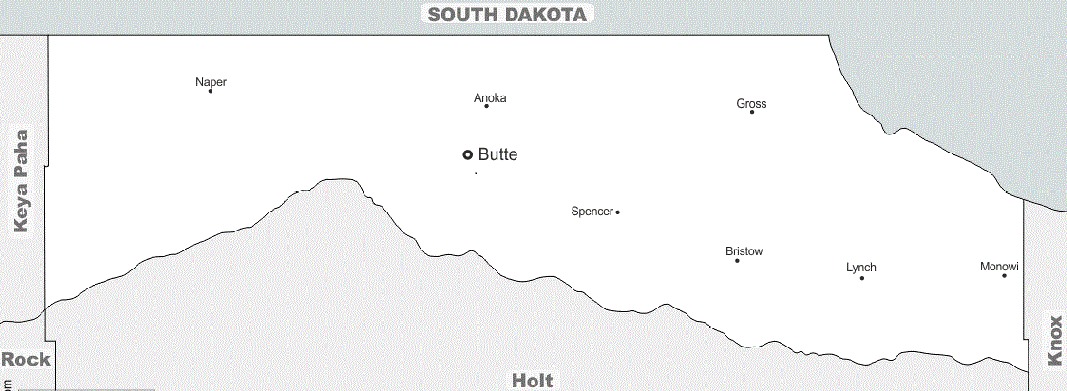
Land Between Two Rivers
Boyd County sits in the far north of Nebraska, bounded by the Niobrara River on the south, the Missouri River on the east and South Dakota on the north. It is long and thin: about 48 miles from east to west, but only about 15 miles across at its widest. Ponca Creek and the Keya Paha River also cross it on their way east to the Missouri, and two landmarks, the Twin Buttes and the Harvey Buttes, rise out of the prairie near Butte.
People lived here long before homesteaders arrived. Near Lynch, archaeologists have studied the remains of a large village of round earthlodges dating to roughly 1450 to 1550. In September 1804 the Lewis and Clark expedition camped along the Missouri within what is now the county, and a highway marker north of Spencer remembers the stop.
Ponca and Sioux Lands
For generations the Ponca made their home where the Niobrara meets the Missouri. An 1865 treaty set aside about 96,000 acres for them in what are now Knox and Boyd counties. Only three years later, the Fort Laramie Treaty of 1868 drew the boundary of the Great Sioux Reservation so that it took in the same Ponca land, apparently because the commissioners overlooked the earlier treaty. That mistake led to the forced removal of the Ponca to Indian Territory in 1877 and, in time, to the famous trial of Chief Standing Bear.
Most of present Boyd County was not part of Nebraska when the state was admitted. The land north of the Keya Paha River was added from Dakota Territory in 1882. Then, in 1889, Congress broke the Great Sioux Reservation into smaller reservations and opened the rest to settlers. Local accounts describe Native families choosing allotments, with many moving north into Gregory County, South Dakota. President Benjamin Harrison proclaimed the land open in February 1890.
Homesteading in the 1890s
Settlers came quickly, and many claimed land as squatters before the surveys and filings caught up with them. Building materials and supplies came by wagon from Niobrara, from Fort Randall, or from railroad towns in Holt County such as O'Neill. Early homes were often dugouts or sod houses, and the first schools and churches were sod as well.
The newcomers were a mix of American-born families and immigrants. Czech families formed large colonies around Lynch and Spencer, Swedish families founded churches near Bristow, and Danish, German and Norwegian families settled among them. Our own Danish immigrant ancestors were part of this wave, taking up land and farming it for generations.
Those first years were hard. Settlers often arrived with very little money, and the summer of 1894 brought a crushing drought: a late frost on May 20 and only about three inches of rain left families with no crop at all. Communities sent men east to ask for help, and Czech settlements in Iowa and Minnesota sent grain and money back. Settlers along the northern edge faced another puzzle: the line between Nebraska and South Dakota was not surveyed until 1895, so some did not know for certain which state they lived in.
A County Takes Shape
The Nebraska Legislature approved a bill creating the county on March 2, 1891, naming it for Governor James E. Boyd, and Governor John M. Thayer proclaimed it organized on August 1, 1891. Butte, then a busy new town of a few hundred people near the center of the county, became the temporary county seat and was later confirmed by voters. More land opened when the old Fort Randall military reservation was released to settlers in the 1890s, and towns such as Gross grew up on it.
The railroad finally came in 1902, when the Fremont, Elkhorn and Missouri Valley line was built west from Niobrara along Ponca Creek toward Bonesteel, South Dakota. It became part of the Chicago and North Western in 1903 and served Monowi, Lynch, Bristow, Spencer and Anoka. Towns the tracks missed, such as Gross and Baker, began to fade. By 1910 the county had 8,826 people, its highest count ever. In 1935 there were more than 1,100 farms, most raising corn, oats and cattle.
Hard Winters, Floods and Today
Weather has always shaped life here. The winter of 1948-49 brought storm after storm across Nebraska, and older residents of Spencer remember the blizzard of 1949 as "the big one." The Army's Operation Snowbound eventually plowed out roads statewide so that families and livestock could be reached. In March 2019 floods struck again, when the Spencer Dam on the Niobrara failed and Ponca Creek flooded Lynch.
Like much of the rural Plains, Boyd County has grown smaller as farms got bigger and young people moved away. The 2020 census counted 1,810 people. The railroad was abandoned in 1978, but the villages, churches and well-kept country cemeteries still mark the places where homesteading families like ours built their lives.
Timeline
- 1804 Lewis and Clark camp along the Missouri in what is now Boyd County (September).
- 1865 Treaty sets aside about 96,000 acres for the Ponca in present Knox and Boyd counties.
- 1868 Fort Laramie Treaty includes the Ponca land in the Great Sioux Reservation.
- 1882 Land north of the Keya Paha River is transferred from Dakota Territory to Nebraska.
- 1889 Congress breaks up the Great Sioux Reservation and opens the remaining land.
- 1890 President Harrison proclaims the land open for settlement (February).
- 1891 Boyd County created (March 2) and proclaimed organized (August 1); Butte named county seat.
- 1894 Severe drought; settlers seek relief from Czech communities in Iowa and Minnesota.
- 1895 Nebraska-South Dakota state line surveyed.
- 1902 Railroad built west from Niobrara through Monowi, Lynch, Bristow and Spencer.
- 1949 Great blizzard; Operation Snowbound opens roads across Nebraska.
- 2019 Spencer Dam fails and Ponca Creek floods Lynch (March).
The family in Boyd County
The family records have 1,340 people who were born, lived, married, died or were buried here. These are the earliest of those who have passed away. Their pages are in the members’ section; you will be asked to sign in.
- Henry Copenhaver born 1822
- Marion Calvin Brown born 1885
- William Ernest Fred Wiese born 1887, lived 1900
- Clara Catherine Christensen born 1889, lived 1900, lived 1910
- Rilla Collins born 1889, lived 1900, buried 1917
- Alice Baker buried 1890
- Gerhardt William Tienken born 1890, lived 1900, lived 1940
- August Hasenpflug born 1891, died 1898, buried
- Henry L. Tienken born 1891
- Pritchett born 1891
- Walter Sedden Spencer born 1891, lived 1900, lived 1910
- Clemen Wilheim Christensen born 1892, lived 1900, lived 1910
- Ethel Andrews born 1892, lived 1920, lived 1930
- John Sobotka born 1892
- Julia Christensen born 1892, lived 1900, lived 1910
- Leon Clarence Mellor born 1892, lived 1900
- Marion Edward Pritchett born 1892, lived 1900, lived 1920
- Martha Ann Baker born 1892
- Vern G. Tork born 1892, lived 1930, lived 1940
- Bessie Darr born 1893
- Clara Ann Rose Reiser born 1893, buried
- David C. Truax Nelson born 1893, lived 1910
- Iva Leora Crawford born 1893, lived 1900, lived 1910
- Jacob George Claassen born 1893, lived 1900, lived 1910
- Leo Trickler born 1893
- Lizzie Clementine Higgins born 1893, lived 1900, lived 1910
- May Moody born 1893, lived 1900, lived 1910
- Ada M. Mulhair born 1894, lived 1900, lived 1910
- Carl John Tienken born 1894, lived 1930, lived 1940
- Clemen Christensen born 1894, lived 1900, lived 1910
- Henry Schollmeyer born 1894
- Horace Alexander Crawford born 1894, lived 1900, lived 1910
- Leonard Edward Fernen born 1894, lived 1900, lived 1910
- Mable T. Mulhair born 1894, lived 1900, lived 1910
- Myrtle L. Moody born 1894
- Paul Hasenpflug born 1894
- Rosie Julia Clara born 1894, lived 1900, lived 1910
- William Thomas Alford born 1894, lived 1900, lived 1910
- Adolph Lihs born 1895
- Andrew Jackson Pritchett born 1895, lived 1900, lived 1950
- Edward Voyd Mulhair born 1895, lived 1900, lived 1920
- Elsie May Schindler born 1895, lived 1900, lived 1910
- Erich Alfred Schultz born 1895, lived 1900, lived 1910
- Frank Klasna born 1895, lived 1900, lived 1910
- Georgia Bowers born 1895, died 1896, buried
- Jens Peter Christensen buried 1895
- Otto Tim Claassen born 1895, lived 1900, lived 1910
- Otto Wagner born 1895, died 1972, buried 1972
- Ruth Jensena Christensen born 1895, lived 1900, lived 1910
- Vera Gertrude Borrall born 1895, lived 1900, lived 1910
- Walter Alford born 1895, buried 1899, died 1899
- Elmer Christensen born 1896, lived 1900, lived 1910
- George Joe Kreycik born 1896, lived 1900, lived 1910
- George Ray Farr born 1896, died 1920
- John Leroy Fernen born 1896, lived 1900, lived 1910
- Phyllis Alford born 1896, lived 1900, lived 1910
- Steven Henry Kreycik born 1896, lived 1900, lived 1910
- Walter James Pritchett born 1896, lived 1900, lived 1920
- James Klasna born 1897, lived 1900, lived 1910
- Jessamine Lihs born 1897, lived 1910, lived 1920
… and 1,191 more.
See also
Sources
- Boyd County history (condensed by Mary Aiken), Boyd County NEGenWeb
- Boyd County history: Rosedale, Bristow, Anoka, Kinkaid (Wade Anderson), Boyd County NEGenWeb
- About Our County, Boyd County, Nebraska (official county website)
- Boyd County, Nebraska (Wikipedia, census tables)
- Boyd County places, census populations 2000-2020 (CityPopulation.de, from US Census Bureau data)
- Czechs in Boyd County, NEGenWeb Project (Nebraska Czech settlement history)
- The Story of the Ponca, Nebraska Studies (NET / Nebraska Department of Education)
- Great Sioux Reservation (Wikipedia)
- Butte, Boyd County NEGenWeb
- Historical sites of Boyd County, Boyd County NEGenWeb
- The Blizzard of 1948-49, History Nebraska blog
- Spencer Dam (Wikipedia)
- When dam burst, here's how one Nebraska town met the epic floods, Christian Science Monitor (April 5, 2019)